There is a particular stretch of Turkish coastline that begins just west of Izmir and unravels southward through some of the most quietly extraordinary landscapes in the Mediterranean. This is not the Türkiye of all-inclusive resorts or package-tour itineraries. It is the Türkiye of stone-laned villages that smell of oregano and sea salt, of ancient harbors where the fishing boats still outnumber the yachts, of turquoise water so clear you can read the seabed from a moving boat. The South Aegean route, from Alaçatı down through Urla, Bodrum, Datça and on to Fethiye, is one of the most rewarding journeys you can make in this country, and the fact that most visitors still fly straight to the resort strips and stay there means you will largely have it to yourself. Grab a cheap flight to İzmir with Pegasus, pick up a hire car, and point it south. Sun, Sea and Simit: Türkiye’s Aegean Turquoise Riviera covers the broader coastal picture, and Why Türkiye’s Coastline Rivals (and Beats) Greece makes the case for why this stretch in particular deserves more attention than it gets.
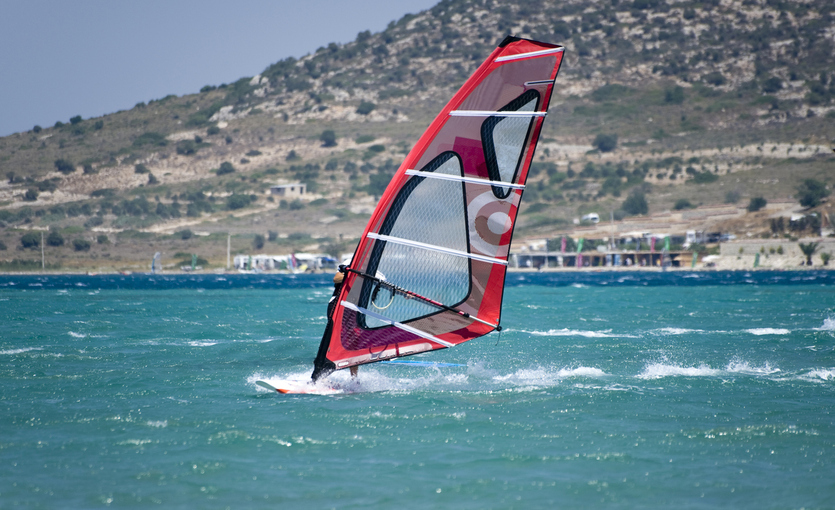
Stop 1: Alaçatı — The Town That Runs on Wind and Good Taste
Alaçatı announces itself gradually. You drive through the flat agricultural plain of the Çeşme Peninsula, past artichoke fields and olive groves, and then suddenly there are stone walls and bougainvillea and a main street narrow enough that two people walking side by side have to negotiate passing a third. The town is built almost entirely from the same honey-colored limestone, and in summer the contrast between the warm stone and the vivid purple of the flowers against it produces a visual effect that explains why every surface gets photographed constantly. But Alaçatı has enough substance to outlast the photography.
The wind is the town’s defining characteristic and its reason for being on any serious traveler’s radar. The Meltem, the prevailing north-westerly that dominates the Aegean from late spring through autumn, funnels through the peninsula’s geography with remarkable consistency, turning the bay just below the town into one of the best windsurfing and kitesurfing spots in Europe. The water is flat, the wind is reliable, and the conditions suit everyone from first-time learners to World Cup competitors, who arrive each summer for the GKA Kite World Cup. Ride the Wind: The Best Kitesurfing Spots in Europe and Türkiye covers Alaçatı in full alongside the other great Aegean wind destinations.
When you are not on the water, the town rewards slow exploration. The Sunday herb and produce market fills the main square with the kind of local intensity that resists tourist softening. The restaurants tucked into the backstreets tend to be run by the same families who have been cooking here for decades, and the local wine culture, built around the Çeşme Peninsula’s distinctive terroir, has produced a generation of small producers doing very interesting things with indigenous grape varieties. 3 Days in İzmir covers how to build Alaçatı into a wider İzmir itinerary if you want to combine the town with the city.
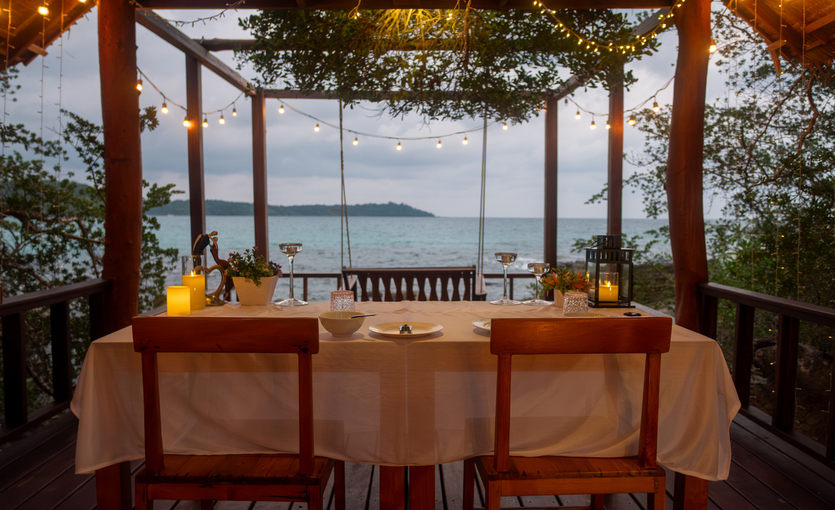
Stop 2: Urla — Art Lanes, Ancient Ruins and the Slowest Possible Afternoon
Thirty kilometers north of Alaçatı but very much its own world, Urla is what happens when a traditional Aegean town decides to take its creative identity seriously without losing the things that made it worth taking seriously in the first place. The old market street, lined with independent galleries, ceramics studios and restored stone buildings housing the kind of bookshops and wine bars that you make a note to return to before you’ve even left, has become one of the most pleasant stretches of pavement on the western Aegean coast. None of it feels manufactured or imposed. The artists were here before the visitors, and that order of arrival is detectable in the quality and confidence of what you find.
The surrounding countryside is just as compelling. The Urla peninsula extends into a series of small bays and headlands dotted with ancient sites, most notably Klazomenai, one of the twelve cities of the Ionian League, whose ruins sit partly underwater in the shallow bay north of the town. The local winemaking culture is distinct from Alaçatı’s and worth engaging with on its own terms: the Urla appellation has attracted some of the most thoughtful producers in Türkiye, and tasting through a flight of local whites with the Aegean a hundred meters away is not a bad way to spend part of an afternoon. Türkiye’s Best Wine Villages You Haven’t Visited Yet covers the broader context of Aegean wine country that Urla sits within.
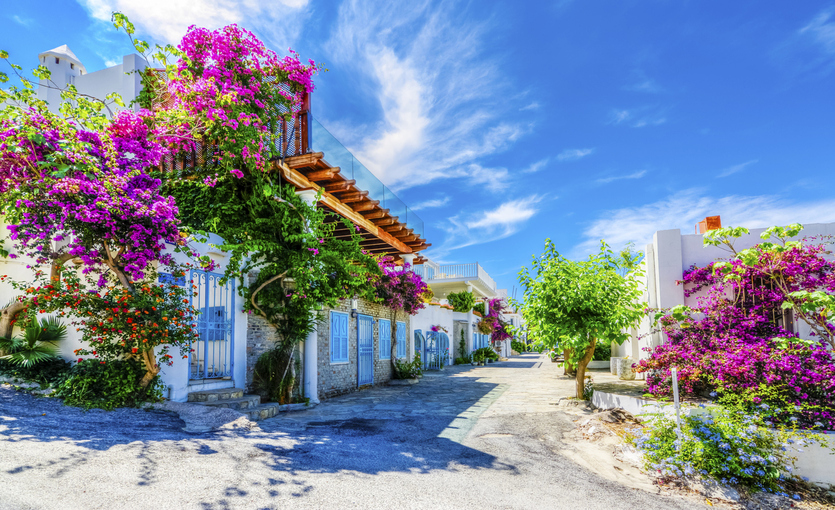
Stop 3: Bodrum — Where Whitewashed Walls Meet a 3,000-Year-Old Harbour
Bodrum is the stop on this route that most people have heard of, and it is worth examining what that reputation actually consists of, because it obscures as much as it reveals. Yes, there are superyachts in the marina and nightlife that runs until dawn in the summer months. But there is also the Castle of St. Peter rising above the twin bays, housing one of the world’s great underwater archaeology museums. There is the ancient theater carved into the hillside above the town, still intact after two millennia. There are the whitewashed cubic houses of the old town, a vernacular architecture so specific and so beautiful that it has influenced how coastal building looks across the whole eastern Mediterranean. Bodrum is the town that gave the world the gulet, the wooden sailing boat that defines Aegean travel at its most unhurried, and the culture of slow coastal exploration that the boat represents is still very much alive here.
The peninsula that extends from Bodrum’s center contains some of the finest coastal scenery in Türkiye, with the bays around Türkbükü, Bitez, and the north coast offering dramatically different experiences within an hour’s drive of the town. For the full picture of what the Bodrum coastline offers, Beautiful Coastal Towns in Turkey to Visit covers the broader region, and Blue Flag and Family Friendly: The Best Beaches in Antalya, Muğla and İzmir breaks down the peninsula’s best swimming spots in detail. Book a cheap flight to Bodrum if you want to join the route at this point rather than driving down from İzmir.
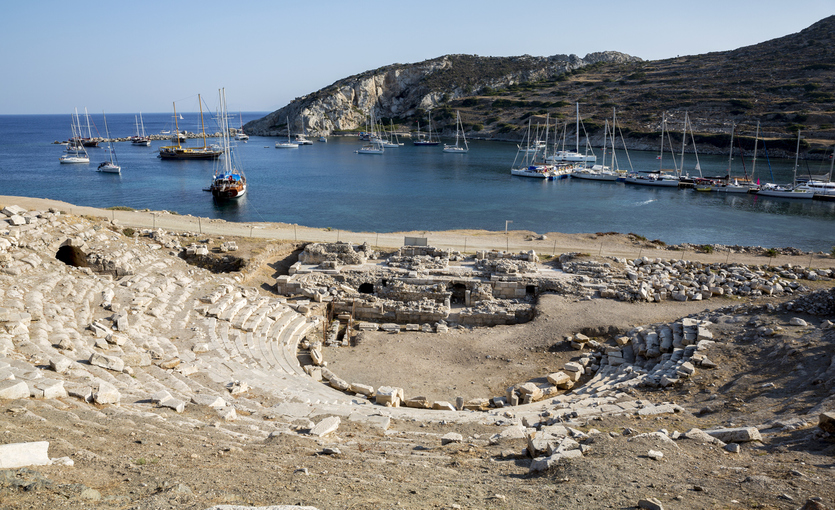
Stop 4: Datça and Knidos — The Peninsula That Ends at the Edge of the Ancient World
The drive from Bodrum to Datça is one of the most beautiful in Türkiye and one of the least driven. The road winds along a narrow peninsula for 70 kilometers, with the Aegean on one side and the Mediterranean on the other, through pine forest and mastic groves and past bays that can only be reached on foot or by boat. The peninsula narrows as you move west, and by the time you reach Datça itself the feeling of having arrived somewhere genuinely remote is very strong, despite the fact that the town has a functioning marina, several good fish restaurants, and a growing number of small hotels run by people who came for a holiday and decided to stay permanently.
At the very tip of the peninsula, accessible by a boat trip or a hair-raising track, lies Knidos: an ancient Greek city built at the confluence of two seas, with a circular harbor whose engineering still looks extraordinary after 2,500 years. The site is largely unexcavated and magnificently atmospheric, with the ruins of temples, a theater, and an odeon scattered across a hillside above water that is simultaneously Aegean and Mediterranean. The famous statue of Aphrodite by Praxiteles, considered by antiquity to be the most beautiful sculpture in the world, stood here. Arriving by boat in the early morning, before the day-trip vessels arrive, and having the site largely to yourself is one of those travel experiences that stays with you permanently. Fly, Ferry, Wander: Türkiye’s Ultimate Island-Hopping Guide covers the broader boat-access culture of the Aegean that makes Knidos reachable.
Stop 5: Fethiye, Ölüdeniz and the Butterfly Valley — Where the Route Earns Its Name
The final stop on this route is where the South Aegean meets the Mediterranean in the most dramatic way imaginable. Fethiye is a working town with a proper market, a harbour full of gulet boats, and a seafront that operates at the pace of a place that has been a port for three thousand years. The Lycian rock tombs carved into the cliff face directly above the town centre are among the most visually arresting ancient monuments in Türkiye, and the fact that they look directly down over a modern town’s cafes and fish restaurants makes them even more affecting. The combination of the functioning city and the ancient presence above it is one of the great urban visual experiences on this coast.
Ölüdeniz, twenty minutes south by road, needs no introduction to anyone who has spent time looking at photographs of Türkiye. The Blue Lagoon is a shallow turquoise inlet separated from the open sea by a sandbank, backed by mountains from which paragliders launch continuously throughout the day, and the water is the color that most water only aspires to be. It holds Blue Flag status and fully deserves it. The beach is genuinely as beautiful as advertised, and the mountain backdrop makes it unlike any other lagoon setting in Europe. The 5 Best Beaches in Turkey covers Ölüdeniz alongside the other top contenders on the Turkish coast.
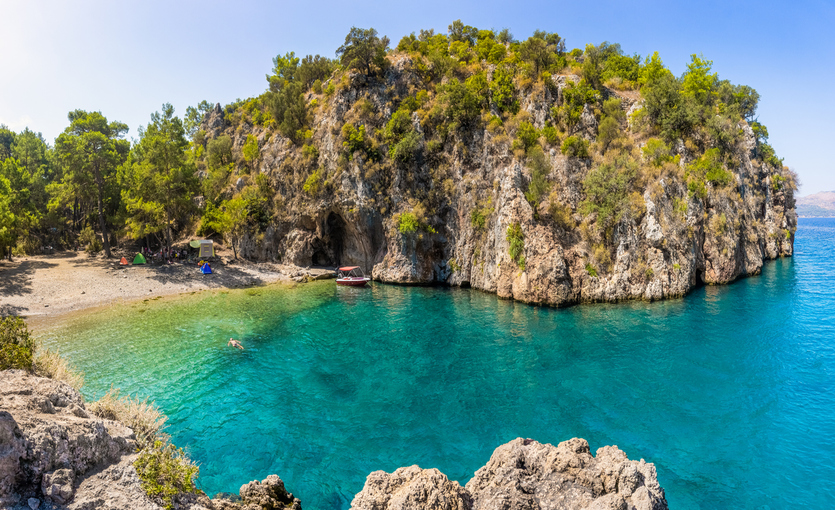
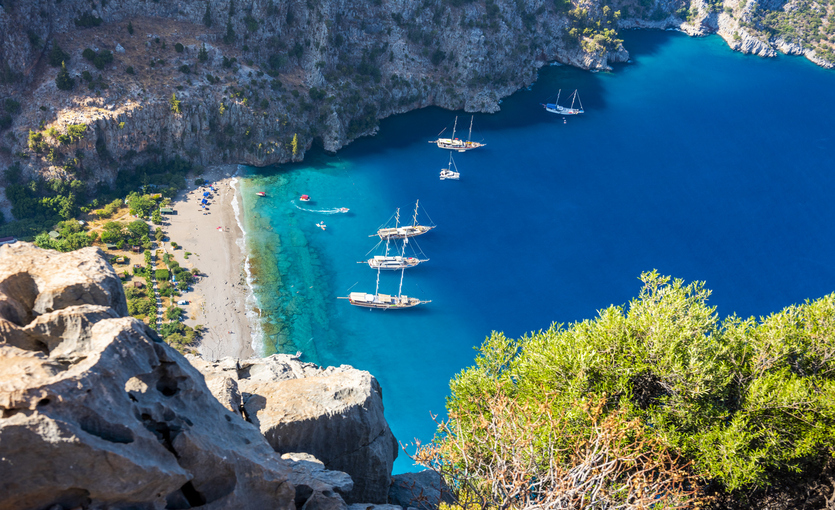
A short boat trip from Ölüdeniz brings you to the Butterfly Valley, a narrow gorge that opens onto a pebble beach accessible only from the water, its walls rising steeply on three sides and the interior colonized in summer by the tiger moth and dozens of other butterfly species. It is the kind of place that makes people seriously reconsider their plans for the rest of the trip. Staying overnight in the valley’s simple camp, waking to the sound of the waterfall at the gorge’s head with no road noise and no schedule: this is what What Does Slow Travel Mean? actually looks like in practice.