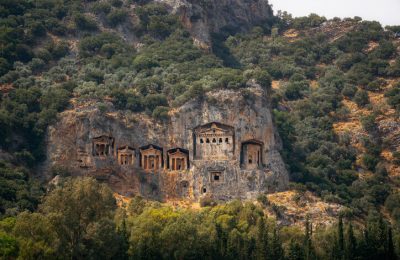
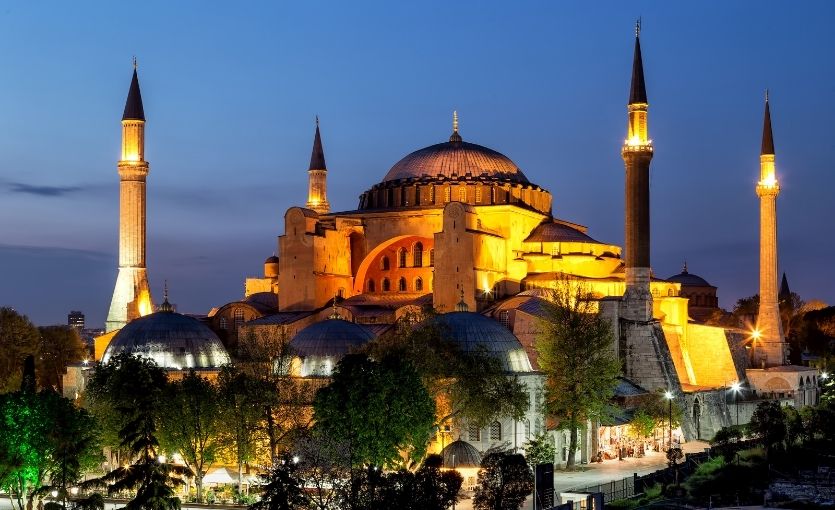
There is something that happens to an ancient site when the tour buses leave and the daylight fades. The crowds thin, the temperature drops a few degrees, and the stones — which spent the afternoon being photographed from every angle by people moving in a hurry — take on a different quality entirely. Shadow and artificial light do things to a Roman theater or a hillside of Hellenistic statues that the full midday sun can’t manage: they isolate, they dramatize, they give back to the ruins some of the mystery that centuries of careful archaeological signage have gently removed. Seeing Aspendos’ theater at night, its 15,000 seats empty and the stage lit against a dark sky, is not the same experience as seeing it in the afternoon. It is considerably better.
Gece Müzeciliği — Night Museology — is a program run by Türkiye’s Ministry of Culture and Tourism that opens selected museums and archaeological sites for evening visits from June 1 to October 1 each year. Launched in 2024 with three sites and now expanded to 20 museums and archaeological sites across the country, the program has already welcomed over one million visitors in its first full year. Entry opens at 19:00 and each venue has its own closing time, ranging from 21:00 to — in the extraordinary case of Nemrut — 4:00 to 9:00 in the morning. Tickets are booked via the official Night Museum portal. Müzekart holders pay an additional 200 TL supplement; foreign visitors pay the standard site entry fee. Here are the eight most compelling stops on the night route, with everything you need to know before you go.
Check the Pegasus route map to plan your connections across the sites — many of these are in different regions of the country, and a well-planned trip can combine two or three in a single week.
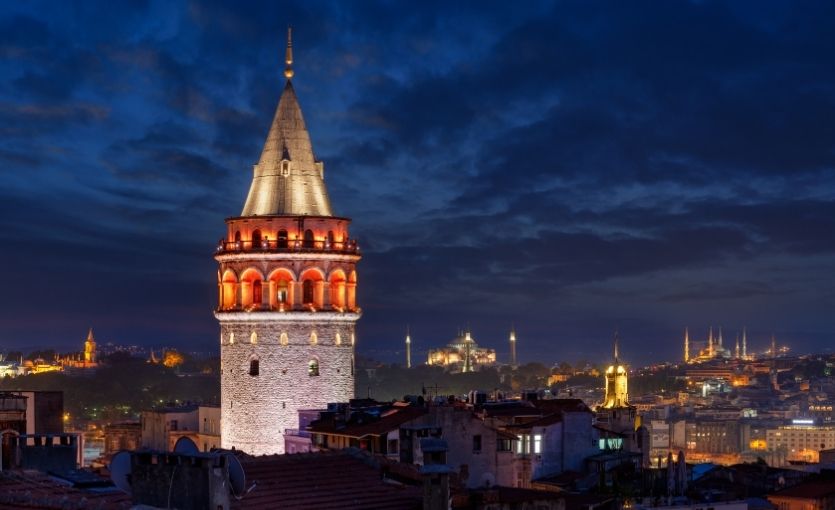
Galata Tower, Istanbul
Open until 23:00
The Galata Tower has watched Istanbul from the same spot since 1348, when Genoese merchants built it as a watchtower at the highest point of their trading colony north of the Golden Horn. At 67 meters tall, it is still one of the most distinctive landmarks on the city’s skyline, and the view from the observation gallery — Bosphorus in one direction, Golden Horn in the other, the minarets of the Old City piercing the sky to the south — is one of the finest urban panoramas in Europe. During daylight hours this view is spectacular. At 22:00 on a warm summer night, with the city lit below and the ferries still crossing the water, it is something else entirely.
The tower is open until 23:00 under the Night Museum program, which means you can time your visit for after dinner, after the worst of the daytime crowds have gone, and in the last hour before closing you will have the gallery largely to yourself. The Galata neighborhood below the tower is one of Istanbul’s most active at night: the lanes around Istiklal Caddesi, the independent cafes and bars of Cihangir, the fish restaurants of Karaköy. A night at Galata Tower is the easiest of the eight stops on this list to incorporate into an existing Istanbul visit, and the hardest to justify skipping. Book via the Night Museum portal — slots fill quickly in July and August.
Getting there: Fly into cheap flights to Istanbul with Pegasus. Galata Tower is in the Beyoğlu district, well served by tram, metro, and taxi from both Sabiha Gökçen and Atatürk airports.
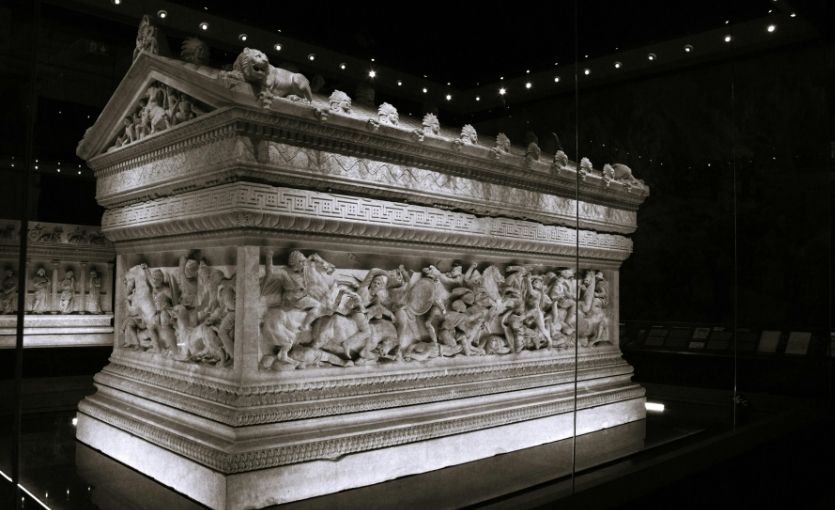
Istanbul Archaeology Museums
Open until 22:00
The Istanbul Archaeology Museums complex — three interconnected buildings near the entrance to Topkapı Palace — contains one of the great collections of ancient art and archaeology in the world, and during the day it receives a fraction of the attention it deserves because most visitors are saving themselves for Topkapı or Hagia Sophia. At night, under the warm outdoor lighting of the courtyard, the Museums take on a different character: quieter, more contemplative, and considerably more atmospheric for the objects inside them.
The main building holds the Alexander Sarcophagus — discovered in Sidon in 1887 and considered one of the finest examples of Greek sculptural art in existence, its relief carvings of battle scenes still showing traces of their original polychrome paint. The Treaty of Kadesh, the world’s oldest surviving peace treaty signed between Ramesses II and the Hittite king Hattusili III around 1259 BC, is here. The Tiled Kiosk, the oldest surviving non-religious Ottoman building in Istanbul, sits in the courtyard. None of these objects require dramatic lighting to be extraordinary, but the evening visit gives you the quiet to actually look at them.
Getting there: Fly into Istanbul (see above). The Museums are adjacent to Topkapı Palace in Sultanahmet, easily walkable from the tram stop.
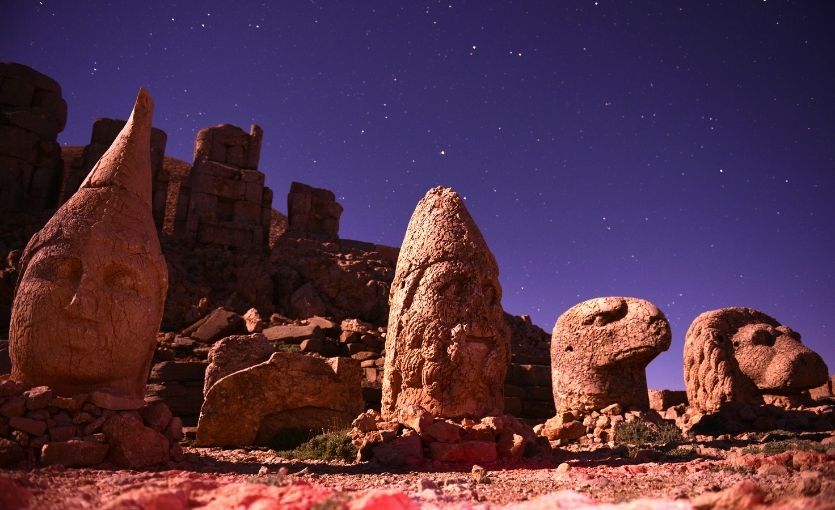
Nemrut Dağı, Adıyaman
Open 04:00 – 09:00 (sunrise hours only)
Nemrut is in its own category among the eight sites on this list, and the category is: experiences that are difficult to adequately describe to someone who hasn’t been there. The mountain summit, at 2,150 meters in the Anti-Taurus range of southeastern Türkiye, is where the obscure first-century BC king Antiochus I of Commagene built his own funerary mound and surrounded it with colossal statues of himself seated among the Greek and Persian gods. The heads of these statues — Antiochus, Zeus-Ohrmazd, Apollo-Mithras, Tyche, Hercules — were toppled from their bodies by earthquakes and now sit on the ground around the terraces in a line, each one several meters tall, staring with eroded stone faces at the horizon.
Under the Night Museum program, Nemrut is open from 04:00 to 09:00 — specifically for the sunrise. There is no other time to come. You drive up to the summit in the dark, in the pre-dawn cold that exists on a 2,150-meter mountain even in July, and you wait with the stone heads and with however many other people had the same idea, and then the sun appears over the eastern horizon and the light hits the statues from the side and they become something that the afternoon photographs cannot prepare you for. It is worth every uncomfortable kilometer of the access road. The Culinary Heart of Türkiye: Adana and Gaziantep covers the broader southeastern region that makes a Nemrut trip worth extending into several days.
Getting there: Fly into cheap flights to Adıyaman with Pegasus. The summit is about 75 kilometers from the city center — most visitors join a guided tour or hire a driver, as the summit access road requires careful navigation in the dark.
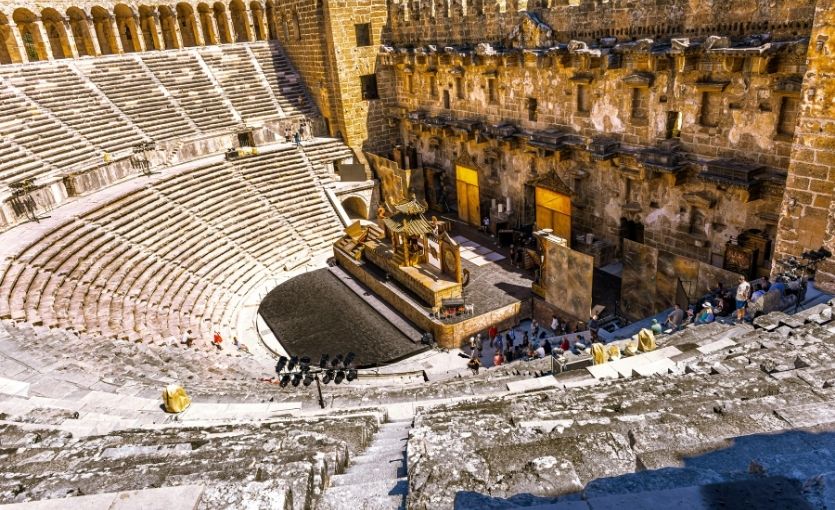
Aspendos, Antalya
Open until 22:00
Aspendos is one of the best-preserved Roman theaters in the world — 15,000 seats, built in the second century AD by the architect Zenon for the Roman Emperor Marcus Aurelius, and still so structurally sound that it is used for live performances every summer. In the afternoon, it shares its extraordinary acoustics with tour groups and the general chaos of a popular archaeological site. At night, under the program lighting with the stage lit and the tiers empty, it becomes possible to understand what this building was actually designed to do.
The scale of Aspendos is comprehensible in a way that photographs don’t fully convey: the stage building rises to the full height of the cavea, the two-story scaenae frons is intact with its columns and decorative niches, and the whole structure sits in a landscape of olive groves and low Taurus foothills that becomes, in the dark, simply a black frame around the lit theater. If there happens to be a performance running during your visit — the Aspendos Opera and Ballet Festival runs through summer — the night museum visit becomes something even more remarkable: an ancient building being used for the purpose it was built for, 1,800 years after construction. Antalya as Your Gateway to 100+ Routes covers the broader Antalya region around Aspendos.
Getting there: Fly into cheap flights to Antalya. Aspendos is about 47 kilometers east of the city — a hire car or organized day trip from the center.
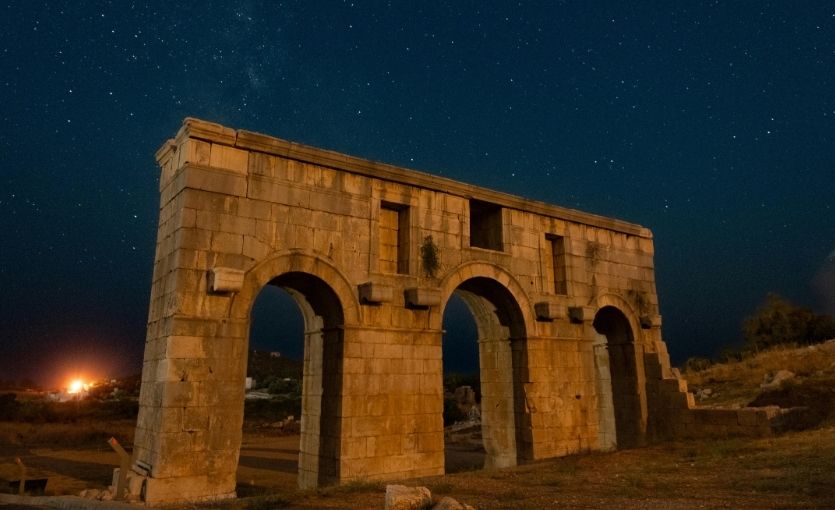
Patara, Antalya
Open until 22:00
Patara was one of the most important cities of ancient Lycia: seat of the Lycian Parliament, home of the oracle of Apollo, and the birthplace — according to tradition — of Saint Nicholas, whose feast day still bears the name of the city’s ancient predecessor in some traditions. The archaeological site is large and partially excavated, running from a monumental triumphal arch at the entrance through streets of columned buildings, baths, warehouses, and temples to the lighthouse at the coast, the oldest known continuously active lighthouse in the world, which guided ships into the harbor for centuries.
At night the site is lit with a restraint that suits it — enough to move safely between the ruins, not so much that the darkness is eliminated. The combination of Lycian history, Roman infrastructure, and early Christian significance in a single site is unusual, and the coastal setting — Patara’s beach, one of the longest in Türkiye, extends for 18 kilometers behind the ruins — gives the evening visit an atmospheric quality that purely inland sites can’t replicate. The lighthouse is particularly compelling after dark: functional for two millennia, now restored and lit, and visible across the water to boats that no longer need its guidance. The Best Places in Kaş covers the surrounding Lycian coast.
Getting there: Fly into Antalya (see above) or cheap flights to Dalaman. Patara is about 70 kilometers west of Dalaman — a hire car is recommended.
Hierapolis, Denizli
Open until 23:00
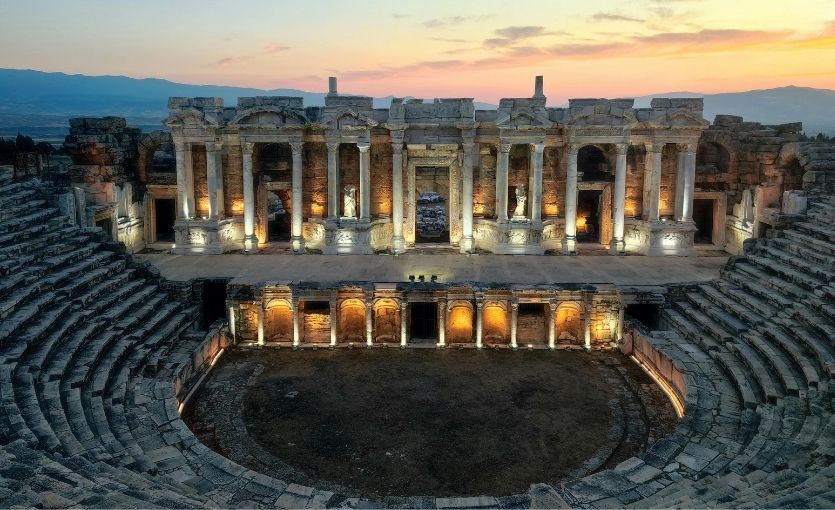
Hierapolis is the ancient city that sits above Pamukkale’s travertine terraces, and it has the longest open hours of any night museum site on the Aegean and Mediterranean coast — 23:00, which means you can spend a full evening here after the daytime visitors to the famous white terraces below have gone. The city was founded as a spa town in the second century BC, built around the hot springs that produce the calcium-rich water that creates the travertines, and it grew into a prosperous Roman and later Byzantine settlement whose ruins are among the most extensive in Anatolia.
The necropolis at Hierapolis is the largest ancient burial ground in Anatolia — over 1,200 tombs, sarcophagi, and grave monuments spread across a hillside north of the city, the deceased buried outside the walls as Roman custom required. Walking through it at dusk, as the light changes from gold to purple and the first stars appear, is not an experience that requires any particular interest in archaeology: it is simply beautiful in a way that ancient landscapes become when the modern world recedes. The Roman theater, capable of holding 12,000 spectators and still largely intact, is lit for evening visitors. Fly into cheap flights to Denizli for the most direct access, or approach via a hire car from the Aegean coast — Hierapolis is about 200 kilometers from İzmir.
Ephesus (Efes), İzmir
Open until 22:00
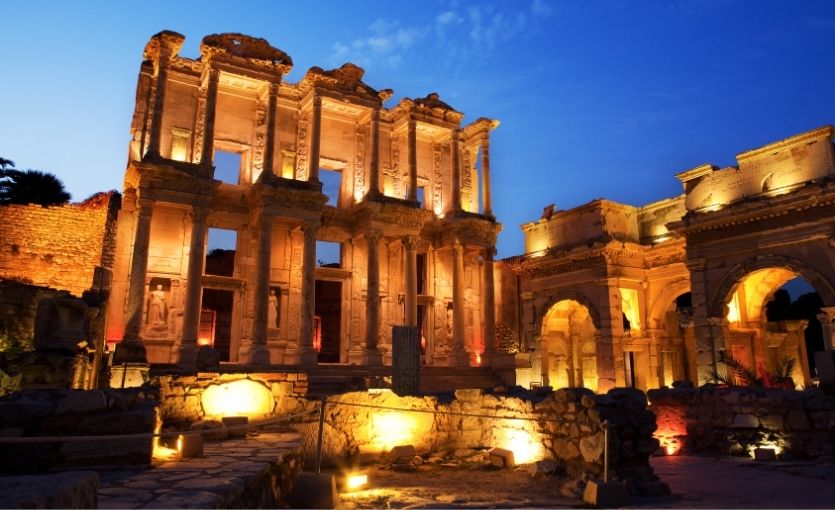
Ephesus was one of the great cities of the ancient world: at its peak, home to 250,000 people, capital of the Roman province of Asia, and site of the Temple of Artemis, one of the Seven Wonders of antiquity. The ruins that remain are the most extensive and best-preserved Roman urban site in the eastern Mediterranean, and during the day they are also one of the most visited, which can make the experience of standing on the marble-paved Curetes Way and looking down toward the Library of Celsus feel more like a queue than a revelation. At night, this changes completely.
Under the Night Museum program, Ephesus is open until 22:00, and the visit that begins after 19:00 is a different site from the one that exists at 2 in the afternoon. The Library of Celsus — its two-story facade one of the most photographed ancient buildings in the world — is lit from below, the Corinthian columns casting shadows upward in a way that inverts the daylight experience. The Great Theater, with its 25,000 seats carved into the hillside, becomes a genuine amphitheater again in the dark: the acoustics that made it functional two millennia ago are still there, audible in the silence between the guided tour commentaries. 3 Days in İzmir covers how to combine Ephesus with a broader İzmir visit, and Sun, Sea and Simit: Türkiye’s Aegean Turquoise Riviera covers the coastal context.
Getting there: Fly into cheap flights to İzmir. Ephesus is about 80 kilometers south, easily reached by train to Selçuk or by hire car.
Derinkuyu Underground City, Nevşehir
Open until 22:00
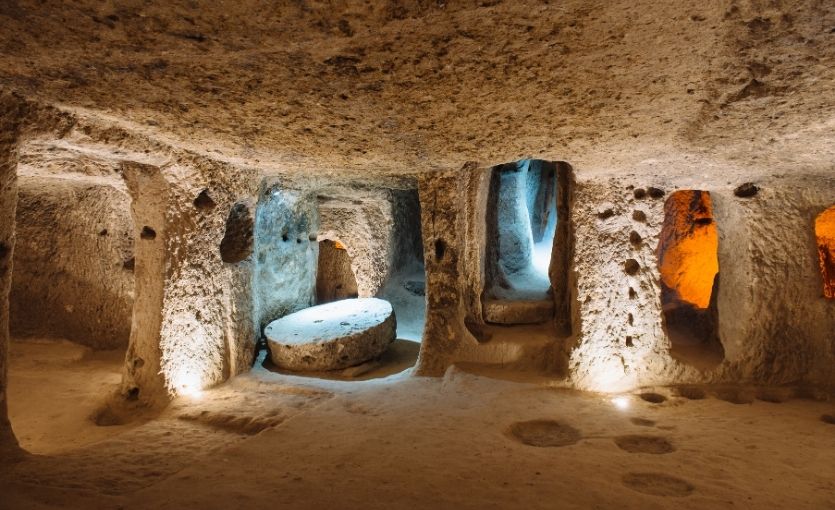
Underground cities are one of Cappadocia’s most extraordinary features — not ruins built above the surface and then buried by time, but cities deliberately carved downward into the soft volcanic rock, room by room and level by level, over centuries. Derinkuyu is the deepest: 85 meters from surface to lowest level, with space for an estimated 20,000 people plus their livestock, food stores, wine presses, schools, chapels, and ventilation shafts. The inhabitants retreated underground during periods of invasion and persecution, pulling massive stone doors across the passages to seal themselves in. The city was connected by a 9-kilometer tunnel to the neighboring underground city of Kaymaklı.
The daytime visit to Derinkuyu involves a great many people moving through tunnels of varying height, some requiring a crouch, in queues that give the experience a slightly anxious quality. The night visit is different: fewer people, the same rock-carved corridors and chambers, and a darkness that the artificial lighting barely interrupts. The temperature underground is a constant 13 degrees Celsius regardless of season, which in July, after a day on Cappadocia’s sun-baked surface, feels like a gift rather than a challenge. The Best Cappadocia Holiday Guide covers the broader region that Derinkuyu sits within.
Getting there: Fly into cheap flights to Kayseri or cheap flights to Nevşehir with Pegasus. Derinkuyu is about 30 kilometers south of Nevşehir center and well-signposted from the main Cappadocia tourist route.
How to Plan Your Night Museum Trip
The Night Museum program runs from June 1 to October 1, 2026. All sites open at 19:00 with individual closing times as noted above. Tickets must be booked in advance via the official Night Museum portal. For holders of the Müzekart (Türkiye’s museum pass card), the night supplement is 200 TL in addition to standard Müzekart access rights. Foreign visitors pay the regular site entry fee at the night rate. Both Turkish and foreign nationals can participate — the program is open to international visitors and the booking process is available in English on the portal.
The eight sites on this list span five different regions of Türkiye, which means building a trip around several of them requires some planning. Istanbul (Galata Tower, Istanbul Archaeology Museums) is a natural starting point for anyone flying into the country. The Antalya cluster (Aspendos, Patara) works well together with a hire car and two or three days in the region — Your Complete Summer Guide to Antalya covers what else to do in the area. Hierapolis and Ephesus are both reachable from İzmir, about two to three hours apart by car. Nemrut and Derinkuyu are the two sites that require the most dedicated routing: Nemrut is in the southeast and works well combined with a Gaziantep or Adıyaman visit, while Derinkuyu is in Cappadocia and best approached from Kayseri or Nevşehir.
Use how to find cheap flights to book connections early — summer is peak demand across all these regions. Check the baggage allowance page before you travel, consider the upgrade package for the flexibility a multi-city itinerary benefits from, and pre-order your meal via the Pegasus Café pre-order menu up to 24 hours before departure. The sites will be waiting when the sun goes down.