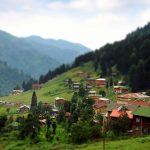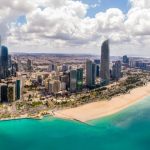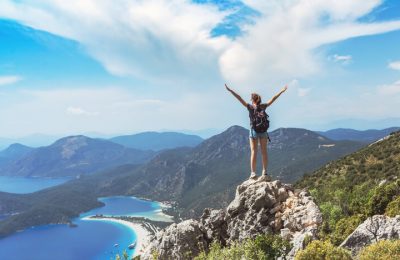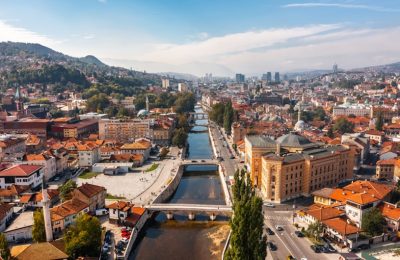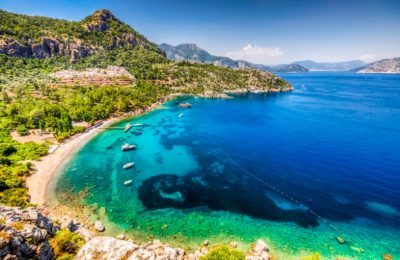
When Christopher Nolan’s The Odyssey opened on July 17, 2026, something interesting happened. Google searches for travel to Troy spiked 3,421 percent in the weeks after release. Searches for flights to the Peloponnese tripled. Sicily and Morocco appeared in set-jetting trend reports across Europe. Nolan had spent 91 days and $250 million filming Homer’s epic across five countries using IMAX cameras — Morocco for Troy, the Peloponnese for the Cyclops cave, Favignana in Sicily for Ithaca, the Aeolian Islands for the monster-haunted straits, Iceland for the Underworld, Scotland for Circe’s island — and the world immediately wanted to go to all of them.
There is, however, a central irony in the film tourism wave that Nolan’s film has generated: the story of the Odyssey begins not in Morocco, not in Greece, not in Sicily — but in Türkiye. The city of Troy, where Odysseus spent ten years fighting before beginning his homeward journey, stands at Hisarlık in the northwestern Aegean province of Çanakkale. It has been confirmed as a UNESCO World Heritage Site since 1998. The Troy Museum, 800 meters from the excavation site, opened in 2018. And searches for flights to Troy increased 966 percent in the weeks after the film’s release, because millions of viewers left the cinema asking the same question: is this real, and can I go there? The answer to both questions is yes. This blog covers the full Odyssey trail — the film locations you can visit, the real Homeric sites that actually match the story, and how the Pegasus network connects you to all of them.
Stop 1: Where the Odyssey Begins — Troy, Çanakkale, Türkiye
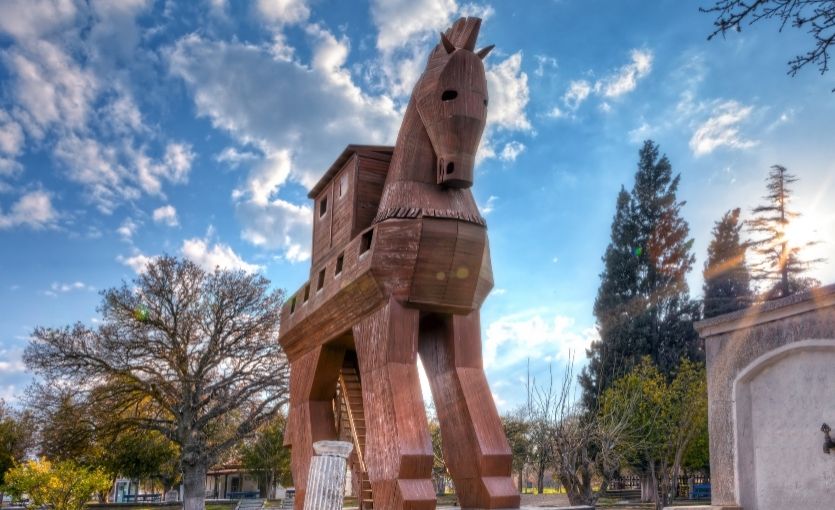
The real site | Film used: Aït Benhaddou, Morocco | Pegasus connection: Istanbul → Çanakkale
The Odyssey opens at the end of the Trojan War. Odysseus’s cunning plan — the wooden horse concealing Greek soldiers — brings about the fall of the city, and then the long journey home begins. For the film, Nolan built and destroyed his version of Troy at Aït Benhaddou, the 17th-century Berber ksar near Ouarzazate in the Moroccan High Atlas — a UNESCO World Heritage Site that has also served as Slaver’s Bay in Game of Thrones and the city of Carthage in Gladiator. The earthen walls and labyrinthine passages of Aït Benhaddou are visually extraordinary and Nolan used them brilliantly. But they are 900-year-old Berber architecture, not Bronze Age Anatolian.
The real Troy is at Hisarlık, 35 minutes by road from Çanakkale. The site has nine distinct settlement layers, spanning from the Early Bronze Age (Troy I, around 3000 BC) to the Roman period (Troy IX, around 500 CE). Troy VI and VIIa, dating to the Late Bronze Age, are the layers most consistent with Homer’s descriptions and the period when Hittite records mention Wilusa — the Hittite name for a powerful city in northwestern Anatolia — in contexts that suggest conflict with the Ahhiyawa (the Hittite name for the Greeks). None of this proves that Achilles and Hector existed. It does prove that powerful states fought over this corner of the Hellespont for centuries, and that the site at Hisarlık is genuinely ancient, genuinely significant, and genuinely worth the journey.
The Troy Museum, designed by Yalin Architectural Design and opened in 2018, holds around 2,000 artifacts on display with more than 40,000 in storage — the material from 150 years of excavation at the site. The museum is 800 meters from the ruins and essential for contextualizing what you see at the site itself. The famous wooden horse replica outside the site entrance is the Instagram moment; the museum is where you actually understand what you’re looking at. Kaz Dağları (Mount Ida) covers the wider northwestern Aegean landscape that surrounds Troy — the mountains where the gods watched the war from above are visible on clear days from the site.
Getting there: Fly to Istanbul with Pegasus and drive northwest — Çanakkale is about 330 kilometers, or take the comfortable overnight bus from Istanbul. Alternatively fly into cheap flights to Balıkesir-Edremit, the nearest Pegasus airport to the region, and drive north. Çanakkale itself is a pleasant base, with the site, the museum, the Gallipoli battlefields, and the Dardanelles crossing all within reach.
Stop 2: Morocco and the Film’s Troy — Aït Benhaddou
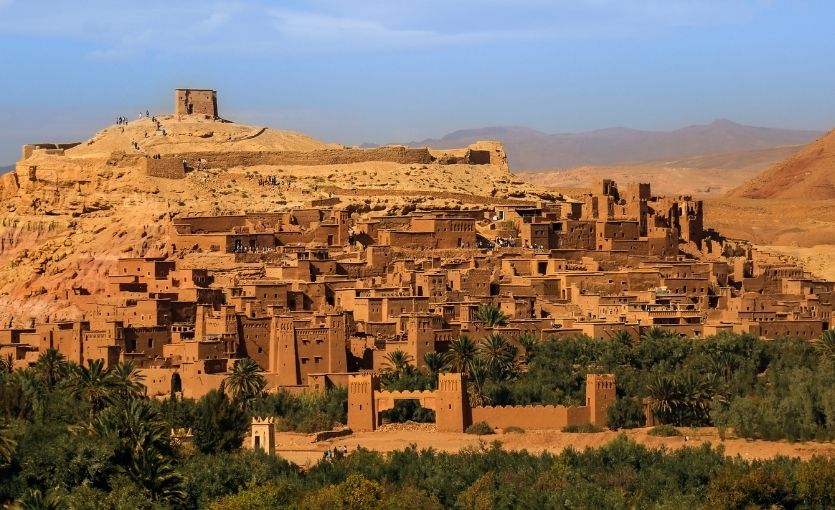
Film location | Scene: Troy, the Trojan Horse, the beginning | Pegasus connection: Casablanca
If you want to visit where Nolan actually filmed the opening sequences — the discovery of the Trojan Horse on the beach at Essaouira, the walled city scenes at Aït Benhaddou — Morocco is the destination. Essaouira, on the Atlantic coast, is a medina city of extraordinary character: blue fishing boats in the harbor, whitewashed walls, a wind that blows constantly off the Atlantic, and a rampart walk around the old city walls that offers views that the film’s drone cameras did justice to. The beach scenes from the opening of The Odyssey were filmed on the long Atlantic strand south of the medina.
Aït Benhaddou, 180 kilometers from Marrakech over the Tizi n’Tichka pass, is one of the most visually dramatic human settlements in Africa. The earthen towers of the ksar rise directly from the dry riverbed, the color shifting from ochre to deep terracotta as the light changes through the day. It is open daily, UNESCO World Heritage Site entry is free, and guided tours through the towers and alleys run from the village on the opposite bank. The best light is in the late afternoon when the towers glow. Combine with Ouarzazate’s film studios — which have hosted Lawrence of Arabia, The Mummy, Gladiator, and now The Odyssey — and with a drive into the Draa Valley for the full Moroccan film-tourism circuit.
Getting there: Pegasus flies to Casablanca. Marrakech is 3.5 hours by train from Casablanca and is the practical base for Aït Benhaddou and Ouarzazate.
Stop 3: The Cyclops Cave — Nestor’s Cave, Peloponnese, Greece
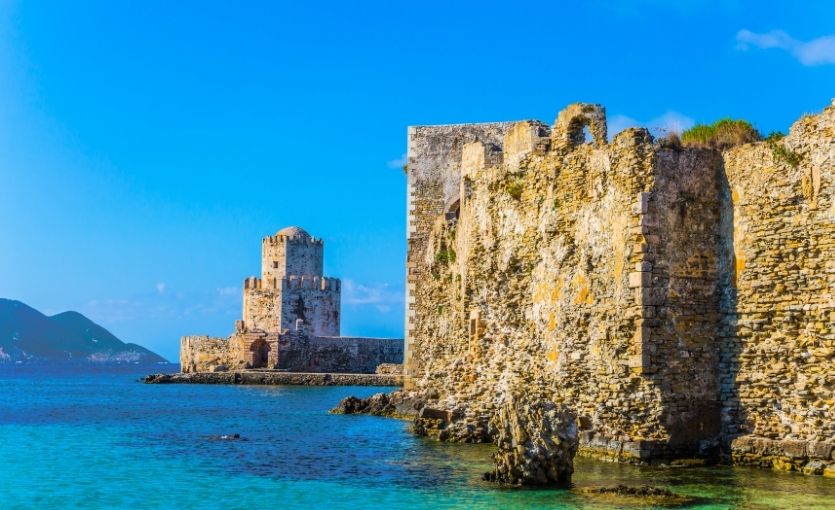
Film location AND real site | Scene: Book IX, Polyphemus | Pegasus connection: Athens
This is the stop where Nolan broke with his own pattern: for the Cyclops sequence, he actually filmed in Greece, in a real cave connected to Homeric tradition. Nestor’s Cave, above Voidokilia Beach in the Messenia region of the southwestern Peloponnese, has a vaulted ceiling 95 feet high and has been used by humans since the Neolithic period. The beach below — Voidokilia, a perfect horseshoe of sand — appears in the film as the ‘Island of the Cyclopes’ where Odysseus and his crew make the reckless decision to explore the cave. The beach is accessible by road from Pylos; the cave itself requires a short climb above the beach.
The wider Messenia region gives the Odyssey traveler an extraordinary cluster of sites. The Palace of Nestor at Englianos, 17 kilometers north of Pylos, is the best-preserved Mycenaean palace on the Greek mainland — the Linear B clay tablets found here in 1939 provided the first decipherment of the script and dramatically expanded our understanding of Bronze Age Greek civilization. Methoni Castle, on a headland south of Pylos, is a Venetian fortress of extraordinary scale with a Byzantine tower standing in the sea on a causeway beyond the main gate, and appears in the film’s background in several coastal scenes. Acrocorinth, the massive ancient fortification above Corinth, was also used for filming.
Getting there: Fly to Athens with Pegasus and drive south through the Peloponnese — Pylos is about 300 kilometers, best done in two legs with a night in Nafplio or Kalamata en route. The Peloponnese is best explored by hire car; the coast road through Messenia is one of the finest drives in Greece.
Stop 4: The Aeolian Islands and Sicily — Scylla, Charybdis and ‘Ithaca’
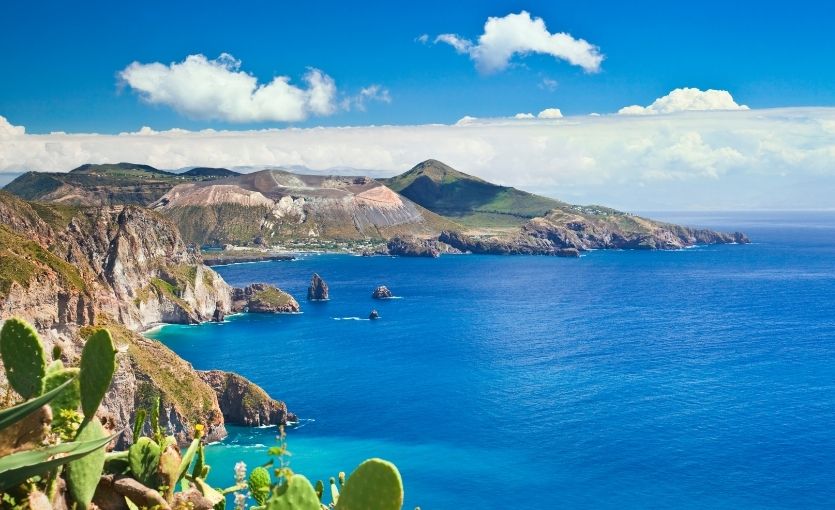
Film locations | Scenes: Books X–XIII | Pegasus connection: Rome or Catania
Nolan chose the Aeolian Islands — the volcanic archipelago north of Sicily — for the monster sequences, and the choice is historically resonant even if he didn’t intend it: ancient Greek tradition consistently located Aeolus, god of the winds, on these islands, and the channel between Sicily and the Italian mainland has been identified with the whirlpool of Charybdis and the six-headed Scylla since antiquity. Basiluzzo, an uninhabited island between Lipari and Stromboli, provided the setting for the Scylla attack. The channel is genuinely dramatic — fast-moving currents, volcanic rock faces rising from the sea, the active volcano of Stromboli occasionally smoking in the background. Organized boat tours from Lipari visit Basiluzzo and the surrounding islands throughout the summer.
Favignana, in the Egadi Islands west of Sicily, became Nolan’s Ithaca — specifically the Castello di Santa Caterina, an abandoned clifftop fortress that provided the visual of Odysseus’s palace overlooking the sea. The castle requires a 30–45 minute hike on an unmaintained slope; bring good shoes and go in the morning before the heat. Favignana town itself is a pleasant base, with crystal-clear water in the quarried coves that made the island famous for tuna fishing.
The real Ithaca — the Greek island of Ithaki in the Ionian Sea — is a separate destination entirely, and one worth visiting precisely because it was not in the film. The island is small, hilly, quiet, and genuinely connected to Homeric tradition through archaeological sites at Pelikata hill, the Cave of the Nymphs, and the village of Stavros. Standing on the island that Homer described as Odysseus’s home, knowing that no film crew has been here, has a different quality from the set-jetting experience and is arguably more honest. 3 Days in Rome: From Ancient Stones to Late-Night Trattorias covers Rome as a base for the Sicily and Aeolian connections — the airport at Fiumicino has good ferry and budget flight connections to the islands.
Getting there: Pegasus flies to Rome and Milan. For Sicily, fly to Catania or Palermo (both connected through Rome or Milan from Pegasus). The Aeolian Islands are reached by ferry from Milazzo, 20 minutes from Catania by train.
Stop 5: Malta — Calypso’s Island Ogygia
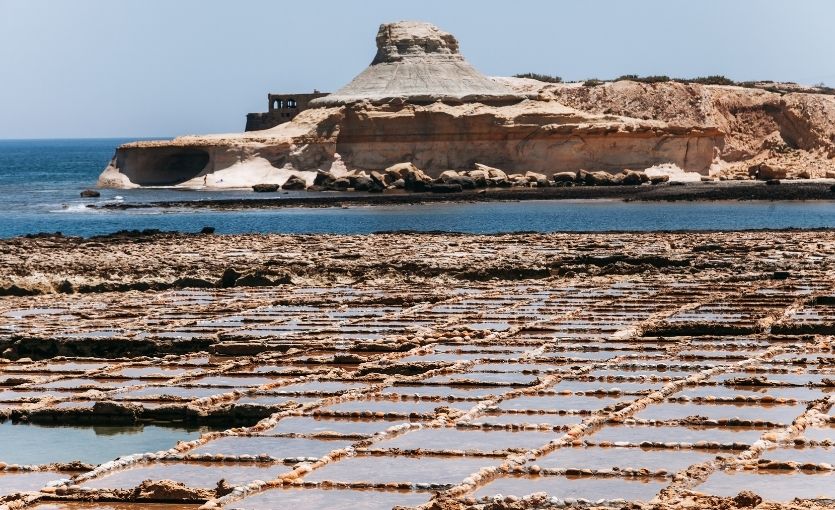
Film location | Scene: Books V–VII, the seven-year captivity | Pegasus connection: Istanbul
For the sequences in which Odysseus is held by the nymph Calypso on her island of Ogygia — seven years of captivity before Hermes delivers Zeus’s command to release him — Nolan used underwater tank facilities in Malta alongside the island’s coastal locations. The identification of Malta (specifically the smaller island of Gozo) with Homer’s Ogygia is an ancient tradition: Calypso’s Cave on the western coast of Gozo has been linked to the story since at least the Roman period and offers extraordinary views over the sea from a natural rock promontory.
Malta itself is one of the most compressed historical environments in the world: Neolithic temples older than Stonehenge, a Phoenician harbor, Roman villa, medieval fortifications, and the Baroque capital Valletta — all within a 316-square-kilometer island. The Blue Lagoon on the small island of Comino, accessible by ferry, provides the Mediterranean swimming that the mythology suggests, and the dive sites around Malta — including the remarkable visibility of the Inland Sea cave on Gozo — are among the best in the central Mediterranean. From Historic Wrecks to Sunken Cities covers the Maltese dive sites in the context of the wider Mediterranean underwater archaeology trail.
Getting there: Malta is connected via Istanbul on the Pegasus network. Check the Pegasus route map for current connection options.
Stop 6: Scotland — Circe’s Island and the Northern Monsters
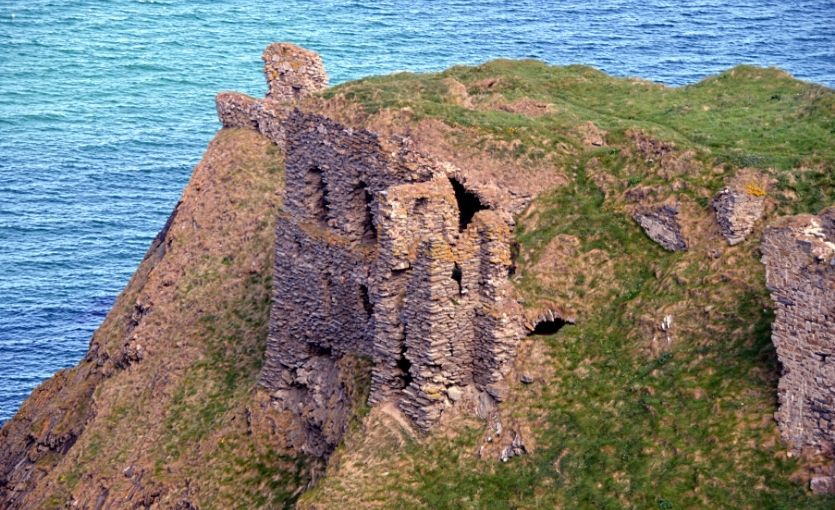
Film location | Scene: Book X, Circe | A detour for dedicated set-jetters
For the island of Circe — the sorceress who turns Odysseus’s crew into pigs — Nolan filmed at Findlater Castle on the Moray Firth in Aberdeenshire, Scotland. The medieval ruin on its cliff above the North Sea has nothing to do with ancient Greece, and Nolan chose it precisely for that reason: the alien quality of the northern Scottish coast against the Mediterranean setting of the rest of the film creates a visual dissonance that makes Circe’s island feel genuinely otherworldly. Findlater Castle is freely accessible on foot from the coastal path, a 20-minute walk from the nearest parking. The Moray Firth in summer has its own compensations: bottlenose dolphins, sea eagles, and a coastline that makes the detour worthwhile for reasons entirely separate from the film.
Getting there: Pegasus flies to Edinburgh directly. Aberdeen is two and a half hours north by train; Findlater Castle is a further 80 kilometers by hire car into Aberdeenshire.
Planning the Full Odyssey Trail
The Two-Week Route
The most complete Odyssey trip covers: fly to Istanbul, drive to Çanakkale and Troy (2 days). Return to Istanbul, fly to Athens, drive the Peloponnese — Corinth, Mycenae, Nafplio, Pylos, Voidokilia, Methoni (5 days). Fly to Rome, train to Catania, ferry to Lipari and the Aeolian Islands (3 days). Ferry to Favignana, fly home from Palermo or Rome. Morocco (Essaouira, Aït Benhaddou) works as an extension before or after. Flight Hacks: How to Plan a Multi-Stop Trip with Pegasus covers the open-jaw booking approach that makes this route significantly cheaper than two return tickets.
The Türkiye-First Argument
The film tourism wave around Nolan’s The Odyssey is primarily directed at Greece and Sicily — the destinations that the film’s PR machine has positioned as ‘where the movie was shot.’ But the story of the Odyssey begins and ends in Türkiye: it begins at Troy, which is in Çanakkale. And the wider Aegean landscape of western Anatolia — the coast that Homer’s own world was embedded in, the landscape visible from the Trojan plain, the Kaz Dağları (Mount Ida) from which the gods observed the war — is on the Pegasus network and almost entirely undiscovered by the set-jetting tourist wave. The Troy Museum sees a fraction of the visitors that the Acropolis does. The wooden horse waits.
Film vs. Reality: The Quick Guide
Troy: Film → Aït Benhaddou, Morocco. Reality → Hisarlık, Çanakkale, Türkiye (UNESCO). Visit both if you can.
Cyclops Cave: Film → Nestor’s Cave, Peloponnese, Greece (Nolan used the real site). Reality → same location.
Ithaca: Film → Favignana, Sicily (Castello di Santa Caterina). Reality → Ithaki island, Ionian Greece.
Scylla and Charybdis: Film → Basiluzzo, Aeolian Islands. Reality → Strait of Messina tradition.
Calypso’s Ogygia: Film → Malta (studio tanks and coast). Reality → Gozo island tradition.
Circe’s Island: Film → Findlater Castle, Moray Firth, Scotland. Reality → ancient tradition places it near the Aeolians.
Use how to find cheap flights to book the Pegasus legs of this trip early. Check the baggage allowance page before you pack — a multi-country itinerary covering Morocco, Türkiye, Greece, Italy and possibly Scotland requires a considered bag. Consider the upgrade package for the flexibility a multi-destination journey benefits from when plans shift. Pre-order your in-flight meal via the Pegasus Café pre-order menu up to 24 hours before departure. Troy is still there. The wine-dark sea is still there. The only thing that’s changed is that 3,421 percent more people are now asking how to get to it.