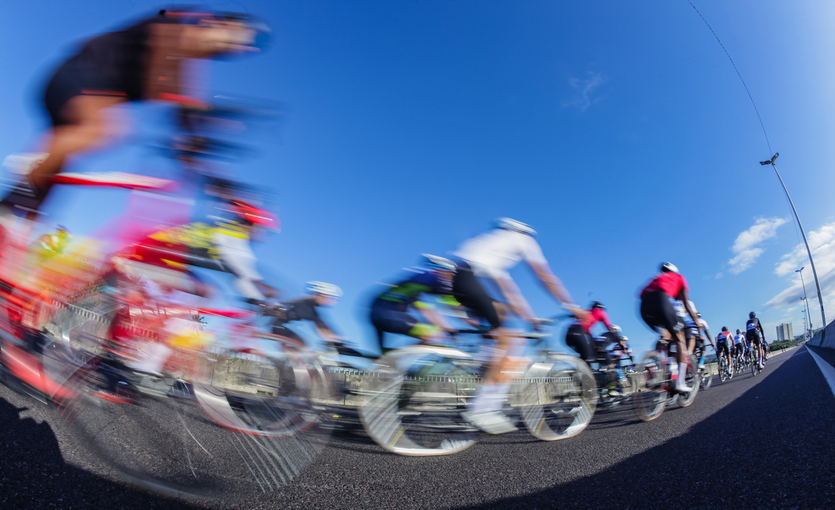
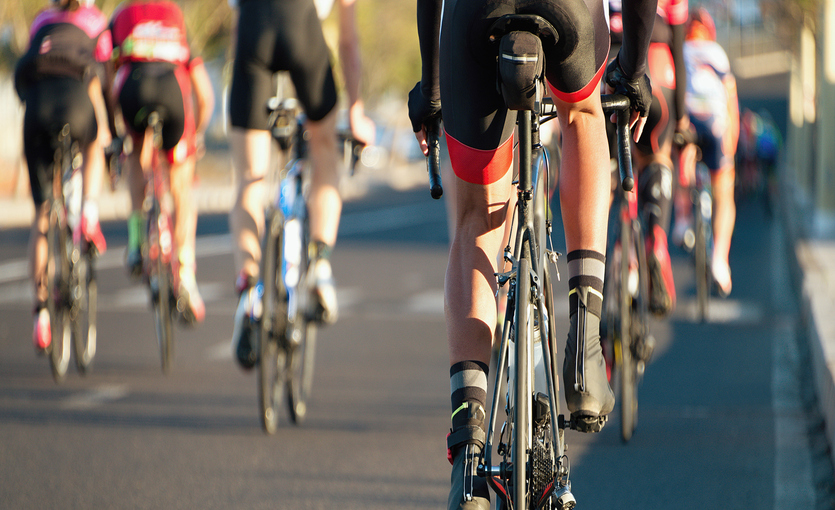
Cycling race riders close-up unrecognizable athletes in motion speed blur action with morning blue sky landscape
Here is the thing nobody tells you about watching the Tour de France from the roadside: the riders are past you in about four seconds. Four seconds, maybe five if it’s a summit finish and they’re grinding. You will wait for hours — sometimes entire days if you want a good spot on Alpe d’Huez — for a blur of color and the whoosh of an aero frame at speed, and then it’s over, and you look at the person next to you and agree that it was absolutely worth it and you’d do it again tomorrow. Which, if you’re following the race, you will. The Tour de France is not really about the racing, or not only about it. It’s about the caravane that passes an hour before the riders and throws promotional junk at you. It’s about the people who have been on the mountainside since Tuesday for a race on Saturday. It’s about the cheese someone three camper vans down is grilling and is definitely going to share. It’s one of the great collective experiences in sport, and the 2026 edition — starting in Barcelona on July 4 and finishing in Paris on July 26 — is shaping up to be one of the most spectacular in years. Book a cheap flight to Barcelona with Pegasus and start planning. The infographic below rates every stage for roadside watchability — use it as your guide.
A Brief History of the Greatest Race in the World
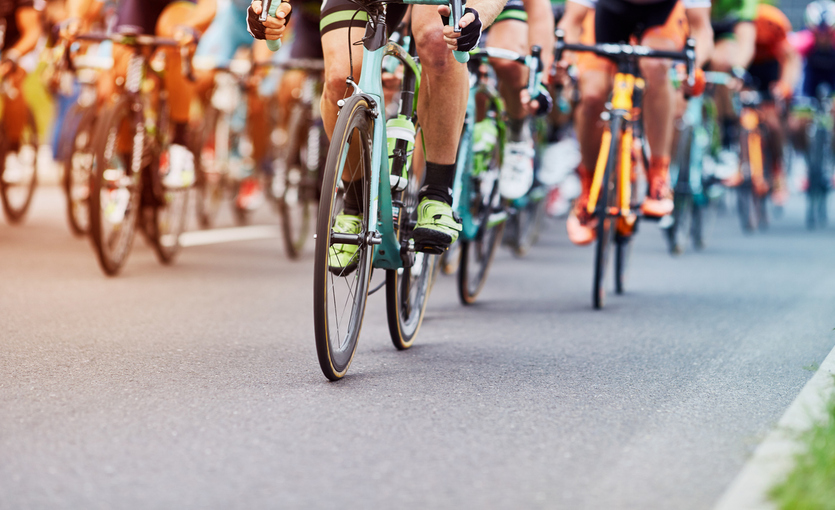
The Tour de France was invented in 1903 by Henri Desgrange, the editor of a French sports newspaper called L’Auto, as a publicity stunt. Sixty riders started. Twenty-one finished. The winner, Maurice Garin, completed the route in just under 95 hours of total riding time. The average speed was under 26 kilometers per hour. Garin also won the following year but was disqualified after being found to have, among other things, taken a train. The race almost collapsed in its early years, repeatedly cancelled or compromised by world wars, cheating scandals, and the sheer brutality of asking human beings to ride bicycles across mountain ranges without adequate food, shelter, or medical support. It survived all of this and became, over the 20th century, the most watched annual sporting event on earth after the Olympic Games.
The mountains came to define the race. The Col du Galibier was introduced in 1911, and the riders who first climbed it described the experience in terms that make modern descriptions of suffering seem understated. The Pyrenees followed. The Ventoux. And then, in 1952, a ski resort in the French Alps called Alpe d’Huez hosted its first Tour stage, and Fausto Coppi — the greatest cyclist alive at the time — won it. The mountain would not return to the route until 1976, but when it did, it became the spiritual heart of the race. Every one of its 21 hairpin bends has been named after a stage winner. Coppi has the first. Eddy Merckx, Bernard Hinault, Greg LeMond, Marco Pantani, Lance Armstrong (crossed out), and a long, complicated, thrilling roster of others follow. In 2026, for the first time in the race’s history, the Tour will summit Alpe d’Huez twice on consecutive days. Stages 19 and 20. The riders will be suffering. The fans will be losing their minds.
Week 1: Barcelona, the Pyrenees and a Sprint to Bordeaux (July 4–12)
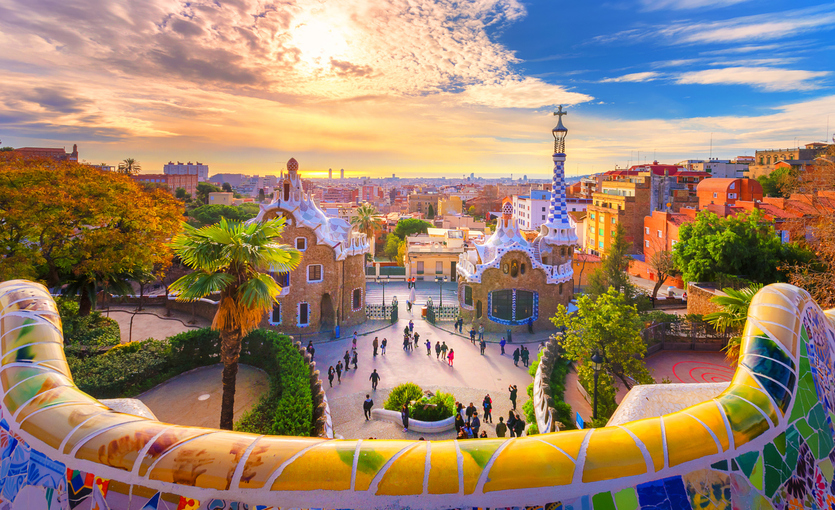
The 2026 Tour begins with something that hasn’t happened since 1971: a team time trial on Stage 1. Twenty-three teams race 19.7 kilometers through Barcelona’s streets, with each rider getting an individual time — a format change that adds tactical complexity from the very first pedal stroke. Both Stage 1 and Stage 2 finish on Montjuïc, the hill above the city that hosted the 1992 Olympic athletics events, and the setting is spectacular: the Olympic stadium as backdrop, the whole city laid out below, and the kind of urban cycling atmosphere that only Barcelona can produce. If you’re making this your base for the opening weekend, our Sun, Sand and a Sea View coverage of Barcelona covers the city in full. Book a cheap flight to Barcelona as early as you possibly can — the Grand Départ draws visitors from across the world and accommodation fills fast.
Stage 3 crosses into France via the Pyrenees — the first real climbing of the race, nearly 4,000 meters of it, finishing uphill at the Pla del Mir ski resort. This is where the general classification contenders will take their first serious look at each other. Stage 6 is the week’s highlight for spectators: the first-ever Tour de France finish at the Cirque de Gavarnie, a UNESCO-listed natural amphitheater of limestone walls rising 1,500 meters from the valley floor. The route gets there via the Col d’Aspin and the Col du Tourmalet, and the setting at the finish is so dramatically beautiful that even people who don’t care about cycling will want to be there. Stage 7 brings the race to Bordeaux for the 83rd time — France’s greatest wine city and the first proper sprint. Fly into cheap flight to Bordeaux for the sprint stages, eat well, and position yourself for Week 2.
Week 2: Bastille Day in the Massif Central, the Vosges and a New Summit (July 13–19)
Stage 10 is July 14 — Bastille Day — and it finishes at Le Lioran in the Massif Central, the same finish used in 2024 where Vingegaard edged Pogačar in a photo finish so close that it required multiple camera angles to determine. The French crowd on Bastille Day is one of the great atmospheres in sport: French flags everywhere, the entire country apparently on the roadside, the collective weight of national expectation pushing French riders toward heroics. Whether or not a French rider wins — and the home crowd will be hoping very hard that one does — the atmosphere is extraordinary regardless.
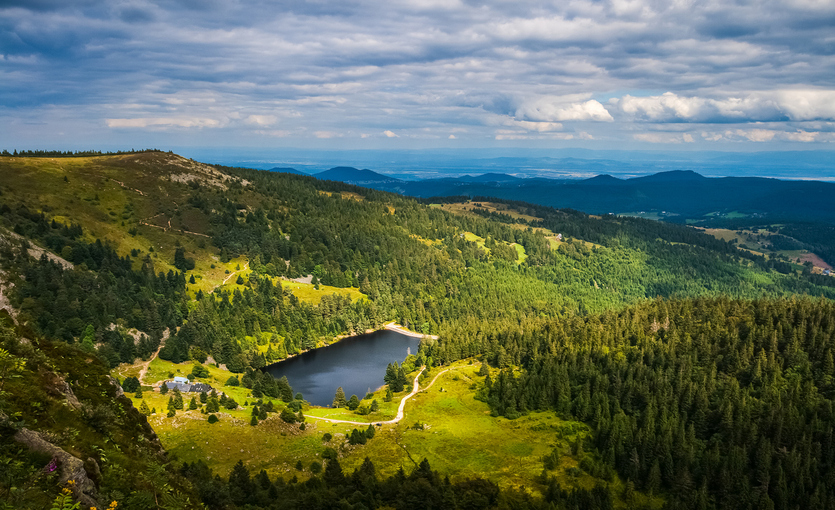
Stage 14 takes the race into the Vosges, the forested mountain range in northeastern France, via the Grand Ballon, Col du Page, Ballon d’Alsace, and Col du Haag, finishing at the Le Markstein ski resort. The Vosges are not as dramatic as the Alps or Pyrenees but they have a particular beauty: dense forest, hilltop villages, and the kind of crowds that come specifically because this isn’t the Alps and you can actually find a spot on the roadside. Stage 15 is the brutal close of Week 2: Champagnole to the Plateau de Solaison, a summit that has never before appeared in the Tour, finishing on an 11.3-kilometre climb at 9.2%. Someone is going to get dropped here, and whoever that is, the GC picture will clarify violently. Fly into cheap flights to Lyon or cheap flights to Strasbourg to access the Vosges stages.
Week 3: The Alps, Two Days on Alpe d’Huez, and Paris (July 20–26)
Stage 16 is the individual time trial between Thonon-les-Bains and Évian-les-Bains on the southern shore of Lake Geneva. This is where riders in time trial suits, on special bikes, alone against the clock, will gain or lose minutes that could decide the entire race. It is not the most exciting thing to watch from the roadside — the riders come through at long intervals, one by one — but the backdrop of Lake Geneva against the Alps is extraordinary and the stage has a drama of its own: every gap that opens here closes options for the days that follow. Stage 18 finishes at Orcières-Merlette, a gentle introduction to the Alps. Stage 19 and 20 are the reason the whole Tour exists.
Alpe d’Huez. Twenty-one hairpin bends, 13.8 kilometers, average gradient 8.1%. The names of stage winners are painted on the road at each hairpin. Turn 7 is Dutch Corner — a section of the climb that has been colonized every Tour visit by Dutch fans, who arrive days in advance, set up their camper vans and makeshift bars, wear orange from head to toe, and produce an atmosphere that has been described, accurately, as the most extraordinary scene in professional cycling. Orange-clad, booze-fuelled fans occupy hairpin seven like a small sovereign nation, bringing their own DJ, their own flag, their own inexhaustible supply of Heineken, and the absolute conviction that they are here for the best possible reason. The church at the corner — Saint-Féréol — once had a Dutch minister who rang the bells after every Dutch victory on the mountain. The corner absorbed that energy and never let it go.
In 2026, the Tour climbs Alpe d’Huez on Stage 19 and then does it again on Stage 20, which has not happened since 2013 and will produce conditions of suffering among the GC contenders that are genuinely difficult to overstate. Stage 20 is likely to be the queen stage: the riders will face the Col du Télégraphe and the Galibier before a second summit finish at Alpe d’Huez, with more than 5,500 meters of climbing in total. Whoever leads the race into Paris after Stage 20 will have earned it. If you can only be at one stage, be at Stage 19 or Stage 20. If you can be at both, do not hesitate. Fly into cheap flight to Grenoble or cheap flight to Lyon. Get to Bourg d’Oisans, the village at the base of the climb, at least the day before. Walk up and find your spot.
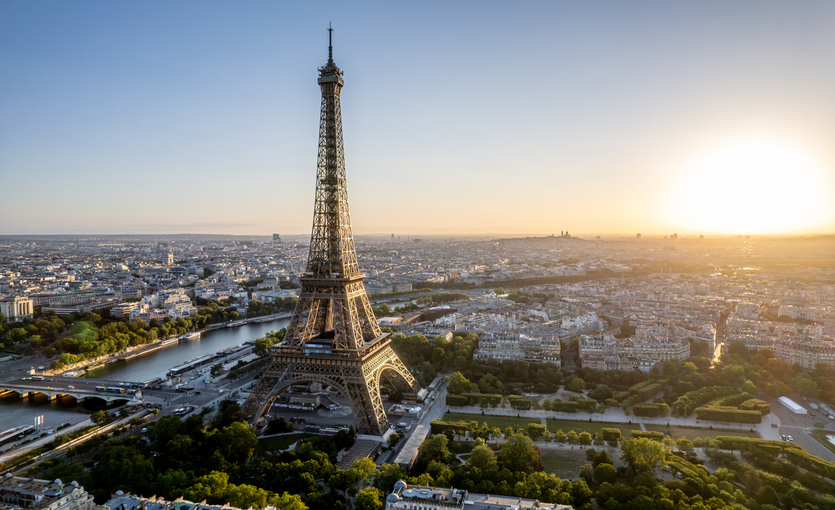
Stage 21 is Paris: the traditional ceremonial finale, with the peloton rolling through Montmartre before the sprint on the Champs-Élysées. The Montmartre climb was used for the first time in 2025 and produced such large crowds and television audiences that it has returned for 2026. The cobbled streets of Montmartre during the Tour are a genuinely unique experience — the peloton at speed on a Parisian hill, tourists and locals mixed on every balcony and terrace, the Sacré-Cœur visible above. Our Paris in 3 Days guide covers where to eat and what to do in the city if you’re building a Paris trip around the finale.
The Practical Guide: How to Actually Do This
Watching the Tour de France from the roadside is free. The route is public road. You turn up, you find a spot, you wait, and then four seconds of brilliant chaos pass and you cheer until your voice gives out. What you do with the hours of waiting is the whole point, and the answer is: bring food, bring something to sit on, find the fans who have clearly done this before and station yourself near them, and enjoy the fact that you are at one of the great events in sport with no ticket, no corporate hospitality, and nothing between you and the riders except a patch of tarmac.
The important practical notes: for summit finishes, you often cannot drive up to the mountain on race day and must either walk, cycle, or take a shuttle bus from the valley. Check the race organization’s website for road closure times, which are typically posted a week in advance. Arrive at mountain stages the day before if you want any hope of a reasonable spot. The caravane — the promotional convoy of decorated vehicles that precedes the race by about an hour — is genuinely entertaining and throws things into the crowd (key rings, sweets, hats, the occasional foam hat in the shape of a tomato). Catch what you can. The Pegasus route map shows connections into Barcelona, Bordeaux, Lyon, Grenoble, Strasbourg, and Paris — the five airports that give you best access to the 2026 route. Use how to find cheap flights to book early: July is peak summer demand across France and Spain. Check the baggage allowance page if you’re bringing camping gear for an Alpe d’Huez overnight, consider the upgrade package for the flexibility a multi-city race-following trip needs, and pre-order via the Pegasus Café pre-order menu up to 24 hours before departure. Then go and wait by a road in France until the fastest cyclists in the world fly past you in four seconds, and understand immediately why people do this every year for the rest of their lives.