Antalya is one of those destinations where the ancient world is not behind glass in a museum but directly underfoot. The province covers a stretch of Mediterranean and Aegean coastline that was, for more than a thousand years, the heartland of Lycian civilization — a culture that built its tombs into cliff faces, organized itself into one of history’s first democratic federations, produced philosophers, athletes and saints, and left behind a density of ruins that no other coastal region of Türkiye can match. From the sunken city at Kekova, where the streets of an ancient town lie visible beneath the water, to the theatre at Aspendos, where concerts still take place in a structure built in the 2nd century AD, the ancient sites around Antalya are not historical footnotes. They are genuinely extraordinary places, and most visitors to the Turkish Riviera have almost no idea they exist.
This guide covers the major sites of the Antalya region in depth: what each one is, what makes it worth visiting, how to get there, and what to combine it with. Fly directly to Antalya from Berlin, Munich, Frankfurt, Stuttgart, Hamburg, Düsseldorf, Cologne and 8 more German cities, plus London, Manchester, Birmingham, Edinburgh and Bristol. Check the Pegasus route map for all connections, and Your Complete Summer Guide to Antalya for beaches, restaurants and the broader destination picture.
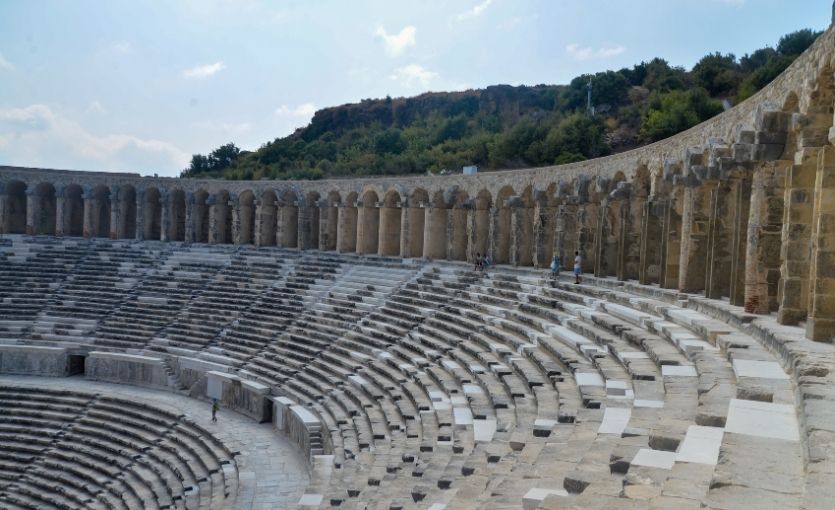
Aspendos: The World’s Best-Preserved Roman Theatre
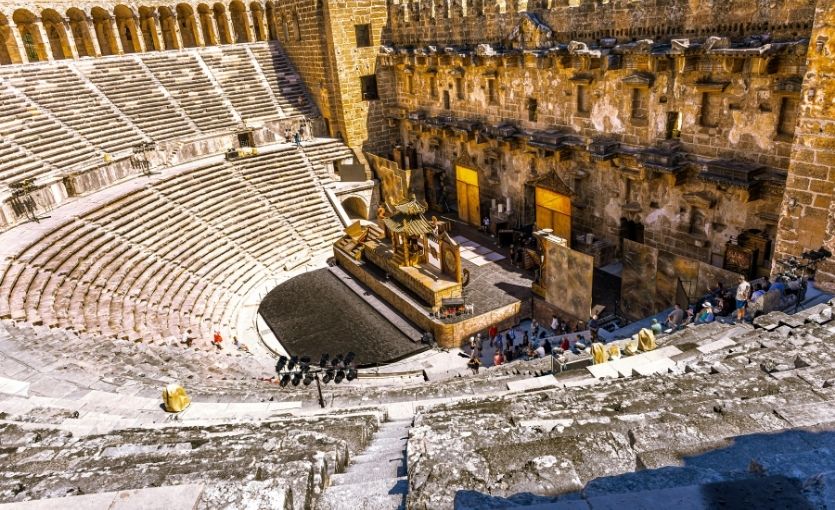
Aspendos has a claim that almost no other ancient site in the world can match: its Roman theatre, built in 155 AD under the Emperor Marcus Aurelius, is the best-preserved ancient theatre in existence. Not the most famous, not the most celebrated — the best preserved. The stage building stands to its full original height. The vaulted galleries are intact. The acoustics work. And the Antalya Opera and Ballet uses it for outdoor performances in summer, which means you can sit in a 2nd-century theatre and watch a live performance in conditions that are essentially unchanged from the original.
The theatre seated 15,000 people and was built by a local architect named Zeno — the dedicatory inscription on the stage building records that it was presented to the gods, the imperial house, and the people of Aspendos. The city itself, a major trading centre in the ancient world, spread across the plateau behind the theatre: the agora, the nymphaeum, the basilica, the bouleuterion and the aqueduct system (one of the most sophisticated in the Roman world) are all accessible on the site. The aqueduct, which carried water from the mountains 20 kilometers away, used a pressurized siphon system at the river crossing — a hydraulic engineering solution that was not independently rediscovered in Europe until the 16th century.
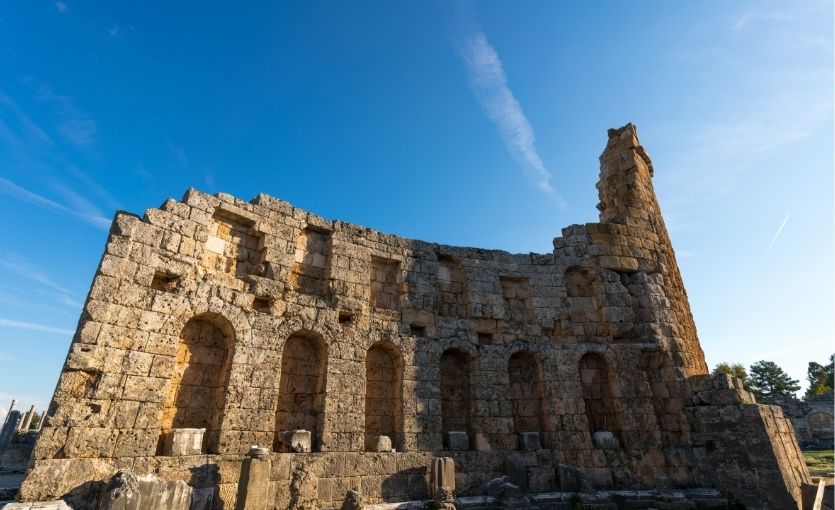
Perge: The Great Colonnaded City Near the Airport
Perge is the site most visitors to Antalya are least aware of and most should visit. It is 18 kilometers from the city center — closer than most airports — and covers an area of more than 1 square kilometer of one of the most important cities of ancient Pamphylia: a colonnaded main street 300 meters long, a stadium that held 12,000 spectators, a Roman bath complex, an agora with an ornamental fountain pool, a theatre cut into the hillside, and the original Hellenistic city gate with its circular courtyard. The marble is still white. The columns still stand. The carved inscriptions on the bases record the names and achievements of real people who lived in this city 2,000 years ago.
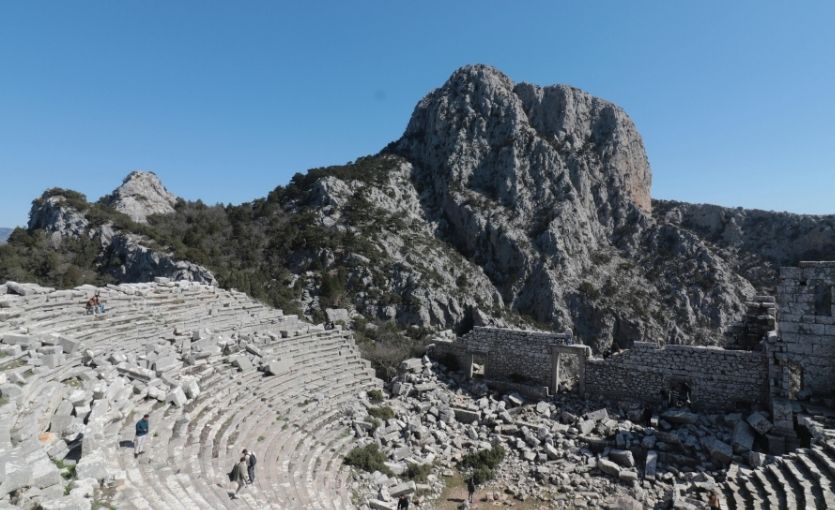
Termessos: The Mountain City Alexander Could Not Take
In 333 BC, Alexander the Great led his army up into the mountains north of Antalya and attempted to take the city of Termessos. He looked at the walls, looked at the terrain, and decided it was not worth the cost. The Termessians had built their city at 1,665 meters above sea level, on a ridge in what is now the Güllük Dağı National Park, and the combination of altitude, cliff faces and fortification made it effectively impregnable. Alexander left. Termessos was never conquered.
What this means for visitors is a site that was never systematically looted, never built over by later cultures, and never stripped of its stone for construction elsewhere. The theatre — carved directly into the rock of the mountainside, with views out over the Taurus range and the coast below — is one of the most dramatically positioned ancient theatres in the world. The necropolis, which spreads across the slopes below the city, has hundreds of rock-cut tombs and sarcophagi in varying states of decay that create a genuinely eerie atmosphere. The hike up from the car park takes 30–45 minutes on a well-marked path through cedar and pine forest. Go in the morning, take water, and allow at least three hours.
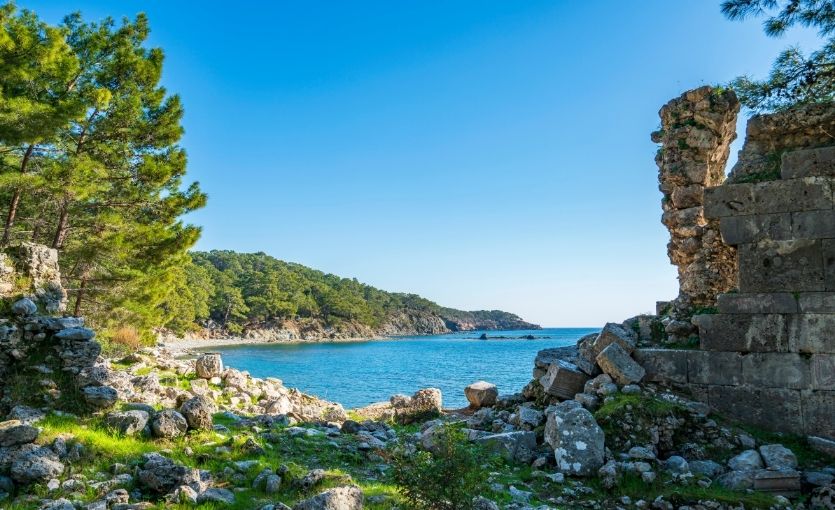
Phaselis: Three Harbours, a Roman Road and Alexander’s Winter Quarters
Phaselis is the ancient site that most consistently produces the reaction: “I cannot believe this exists and nobody told me about it!” The Lycian city, founded in the 7th century BC and occupied through to the Byzantine period, sits on a pine-forested headland between three bays — a northern harbor, a central harbor and a southern harbor — and the ruins are not roped off and managed from a distance but scattered directly between and around the beaches, so that the walk from the entrance takes you past the arched gate of the Roman aqueduct, along the colonnaded main street, and down to the water’s edge where the southern harbor’s ancient breakwater is still visible beneath the surface.
Alexander the Great wintered here in 333 BC — the city gave him their keys in welcome — and used the northern harbor as his base while his army marched the Lycian coast. The site is inside the Olympos-Beydağları National Park, which means the surrounding pine forest is protected and the beaches remain clean and uncrowded by comparison with the main resort strips. Combine Phaselis with Olympos and the Chimaera flames for the full ancient-coast day: arrive at Phaselis for the morning, swim at midday, drive to Olympos in the afternoon, and climb to the Chimaera at dusk when the flames are most visible.
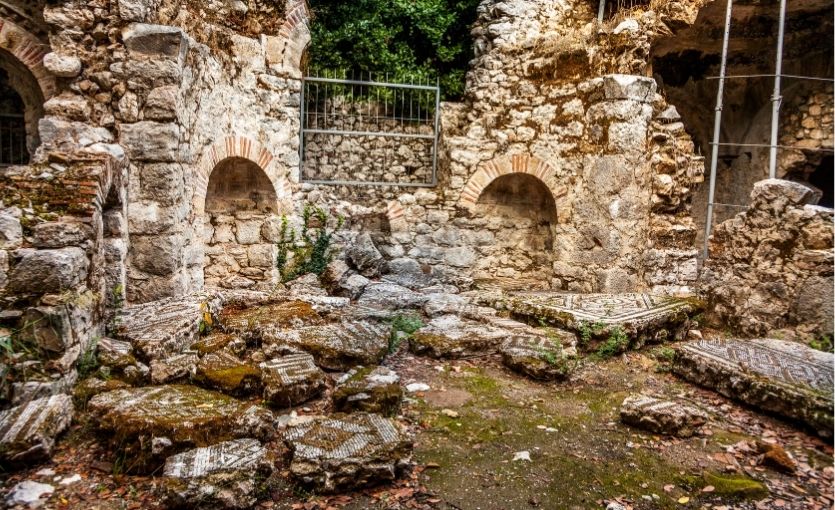
Olympos: Ancient City at the Beach, Eternal Flames on the Hillside
The ancient Lycian city of Olympos — an entirely separate site from the Greek Mount Olympus, which is in northern Greece — occupies a river valley that runs down to a beach, and the ruins are distributed throughout the valley in a way that makes the boundary between archaeology and nature almost invisible. The Roman baths stand in the undergrowth. Byzantine walls cross the stream. Sarcophagi sit in the riverbed. The beach at the end of the valley, backed by pine and plane trees and accessible only by foot through the ruins, is one of the most atmospheric beaches on the Turkish coast.
Three kilometers above the valley, the Chimaera — the natural methane flames that seep through fissures in the rock of Mount Olympos — have been burning continuously for at least 2,500 years. The ancient Greeks believed they were caused by a fire-breathing monster; Homer mentions the flame-bearing rock in the Iliad; the flames were used as a navigation landmark by sailors crossing the eastern Mediterranean. The 30-minute climb to the Chimaera from the trailhead at Çıralı village is well-lit until dark and worth doing in the evening when the flames are most dramatic against the night sky. From Historic Wrecks to Sunken Cities covers the underwater archaeology at Olympos’s coastline.
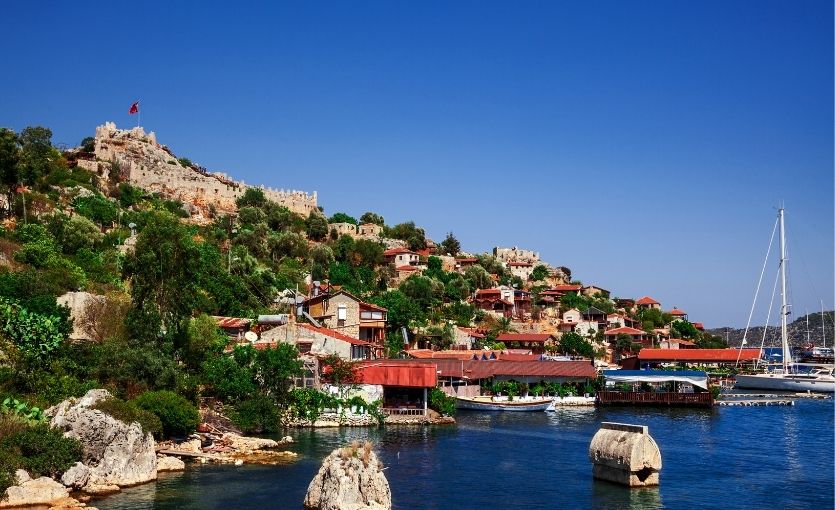
Kekova: The Sunken City You Swim Over
Kekova is, simply, the most unusual ancient site in Türkiye. The island of Kekova, in the bay west of Kaş, protects a sheltered channel of water so clear that the streets and walls and staircases of an ancient Lycian town are visible from a boat on the surface — a city that went into the sea gradually during a series of earthquakes in the 2nd century AD and was never rebuilt. Swimming directly over the ruins is prohibited (to protect them), but the boat tours that operate from Üçağız and Kaş take you along the full length of the sunken city at close quarters, and on calm days the level of detail visible through the water is extraordinary: doorways, storage chambers, column bases, harbor installations.
The village of Simena, on the hillside above the channel, is one of the smallest and most unspoiled settlements on the Lycian coast — accessible only by boat, with a small Byzantine castle on the hilltop whose battlements enclose a Lycian rock tomb. The combination of the boat trip, the sunken city, Simena castle and a swim in the channel constitutes one of the best half-days available anywhere on the Turkish Mediterranean.
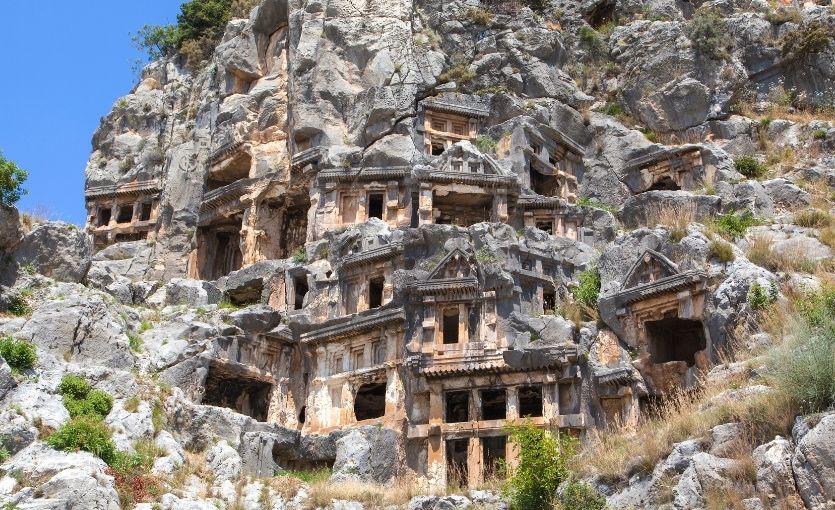
Myra: Rock Tombs, St. Nicholas and the Face Behind Santa Claus
Myra was one of the most important cities of the Lycian League — a major port, a seat of government, and from the 4th century AD, the home of a bishop whose generosity to the poor became the foundation of one of the most widely known figures in Western culture. Nicholas of Myra, who served as bishop here in the early 4th century, was renowned during his lifetime for giving gifts anonymously to those in need. After his death, the Basilica of St. Nicholas was built over his tomb in what is now the town of Demre — and from there, via the Crusades, via Dutch seafarers who carried the tradition to America, via Washington Irving and Clement Clarke Moore, a 4th-century bishop from a small city on the Turkish Mediterranean coast became Father Christmas.
The ancient site of Myra itself is dominated by the finest collection of Lycian rock-cut tombs in the region: dozens of tombs carved directly into the cliff face above the ancient theatre, many with elaborate carved facades depicting reclining figures and battle scenes. The theatre, partially buried by the Myros river’s flood deposits, is being excavated on an ongoing basis and is among the most atmospheric on the coast. The Basilica of St. Nicholas, in Demre town, is a 5th-century Byzantine church that houses the sarcophagus (now empty — the bones were taken to Bari in 1087) and extraordinarily well-preserved floor mosaics.
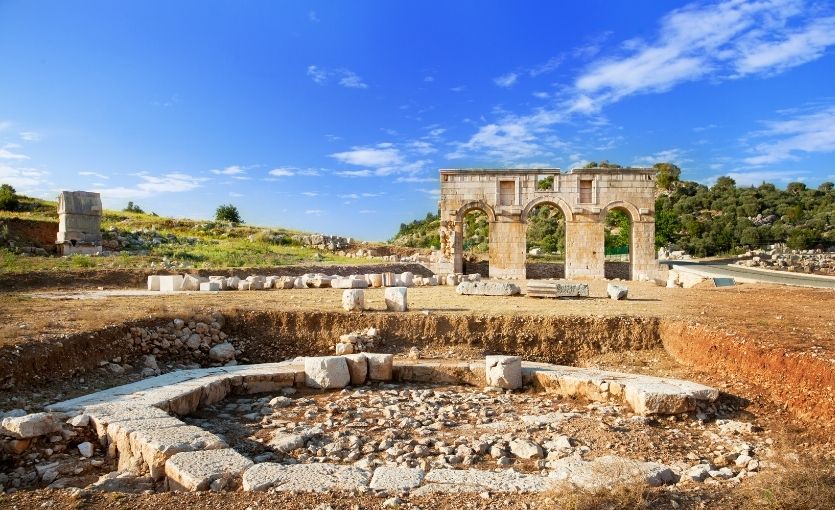
Patara: Birthplace of Apollo, Parliament of the Lycian League and the Longest Beach
Patara holds a combination of distinctions that no other site in the region can match. It was, according to ancient tradition, the birthplace of Apollo — the oracle at Delphi was believed to spend winter here. It was the seat of the Lycian League’s parliament — the 23-member federal council whose proportional representation system was explicitly cited by the American Founding Fathers as a model for the US Senate. And the beach that stretches in front of the ancient city — 18 kilometers of uninterrupted sand, entirely undeveloped, protected as a loggerhead sea turtle nesting ground — is the longest beach in Türkiye.
The ruins include a monumental arch at the city entrance, a lighthouse (the oldest in the world that is still standing as a recognizable structure, dating to the 1st century BC), a theatre, a parliament building, granaries, a triumphal arch and the harbor — now silted up and turned to wetland, with flamingos. The combination of the ruins and the beach means you can spend a morning on one of the finest ancient sites on the coast and an afternoon on one of its finest beaches. The walk between the two takes about fifteen minutes.
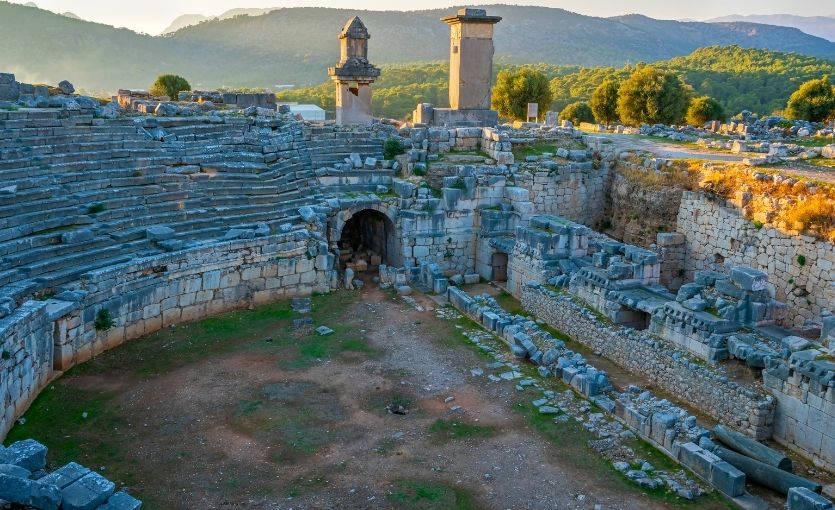
Xanthos and Letoon: The Twin UNESCO Sites of the Lycian Heartland
Xanthos and Letoon are listed together as a single UNESCO World Heritage Site, and they should be visited together — the two cities are 4 kilometers apart and together tell the full story of Lycian civilization at its height. Xanthos was the capital of the Lycian League: the political, cultural and religious center of a civilization that stretched along this coast for five centuries. The Nereid Monument — the carved frieze that decorated a tomb here in the 4th century BC — is now in the British Museum in London, as is the Xanthos Obelisk with its trilingual inscription. What remains on site are the theatre, the Byzantine basilica, the remarkable Harpy Tomb pillar (the original friezes replaced with casts), and the extensive excavations of the lower city.
Letoon, 4 kilometers south, was the federal sanctuary of the Lycian League — the sacred site dedicated to the goddess Leto (mother of Apollo and Artemis) where the federation held its religious ceremonies and where the inscriptions recording Lycian League decrees were set up. Three temples stand side by side: one to Leto, one to Apollo, one to Artemis. The site is partially flooded — the water table rises into the orchestra of the theatre — and the effect, with frogs and reeds in what was once the performance space, is quietly extraordinary. The bilingual Greek-Lycian-Aramaic inscription found here was the key that unlocked the decipherment of the Lycian language.
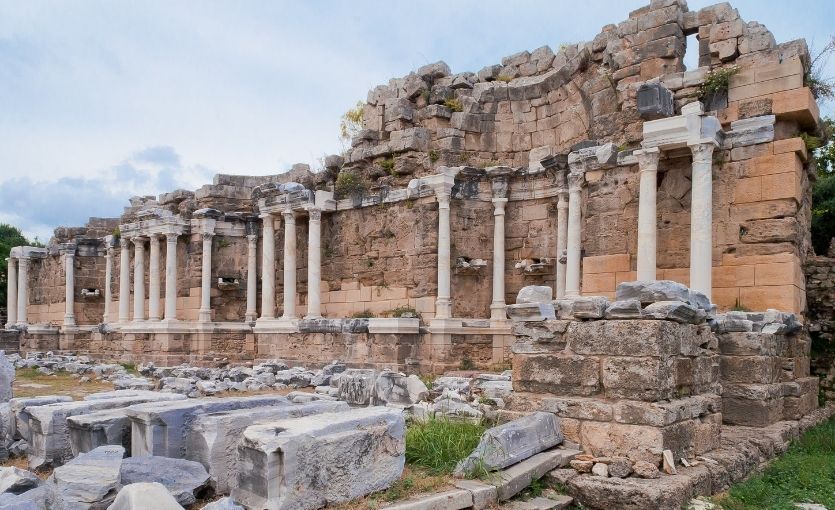
Side: Temple of Apollo at Sunset and the Archaeology Museum in the Ancient Baths
Side is simultaneously the most visited ancient site in the Antalya region and one of the most genuinely impressive. The modern resort town of Side occupies the same peninsula as the ancient city — which means the Roman columns and Byzantine walls are embedded among the hotels, restaurants and beach clubs, and the approach to the Temple of Apollo at the peninsula’s western tip takes you past both kebab restaurants and 2nd-century granite columns. This sounds like it should be jarring. In practice, the accumulated effect of walking a peninsula covered in ancient stonework — the Vespasian monument in the town square, the theatre that seated 15,000, the colonnaded main street, the nymphaeum, the agora — is genuinely impressive regardless of the tourist context around it.
The Temple of Apollo, overlooking the sea at the western tip, is the photograph that every travel piece about Side uses and the site that every visitor to the resort goes to watch at sunset — for good reason. The remaining columns and the carved Medusa head on the temple’s frieze, lit by the last light of the day with the Mediterranean behind, is an image that justifies the journey. The Archaeology Museum of Side, housed in the late Roman bath complex near the main gate, holds the finest collection of Roman sculpture from the region: a room of portrait busts whose subjects look directly at you across twenty centuries with a specificity that no generic statue achieves.